)
Amazon Web Services (AWS): Complete Guide to AWS Cloud Computing
Amazon Web Services (AWS) is a leading cloud computing platform that helps individuals, startups, and businesses access powerful technology over the internet. Instead of buying and maintaining physical servers, organizations can use cloud computing to run applications, store files, manage databases, and build digital solutions.
AWS provides a wide range of cloud services, including computing, storage, networking, security, analytics, and artificial intelligence. Its flexible infrastructure allows businesses to increase or reduce resources based on demand. AWS also follows usage-based pricing, which can help organizations control infrastructure costs. Today, Amazon Web Services supports companies across industries and plays an important role in modern cloud infrastructure and digital transformation.
What Is Amazon Web Services (AWS)?
Amazon Web Services is a collection of cloud-based technology services. It provides cloud infrastructure that businesses can use to run applications, store information, manage databases, and build digital products.
How Does AWS Work?
How AWS works is simple. Users select the resources they need through the AWS cloud platform. For example, Amazon EC2 can run an application, Amazon S3 can store files, and Amazon RDS can manage a database.
Why Was AWS Created?
AWS was created to make computing resources available on demand. Instead of purchasing expensive hardware, companies can rent cloud resources and increase or decrease them as needed.
Who Uses AWS?
AWS for businesses includes startups, small companies, enterprises, developers, healthcare organizations, financial institutions, retailers, and many other industries.
What Are the Main AWS Cloud Services?
AWS offers hundreds of AWS services. The most important categories include computing, storage, databases, networking, and security.
AWS Compute Services
Amazon EC2 provides virtual servers for running applications. AWS Lambda allows developers to run code without managing traditional servers.
AWS Networking Services
AWS VPC creates a private virtual network for AWS resources. It helps control IP addresses, subnets, routing, and network access.
AWS Security Services
AWS IAM controls access to AWS resources. Cloud security also includes encryption, monitoring, identity management, and network protection.
AWS Artificial Intelligence and Machine Learning
AWS supports machine learning and generative AI applications. Businesses can use AWS to build intelligent applications, automate tasks, analyze data, and create AI-powered customer experiences.
What Is AWS Generative AI?
Generative AI can create text, code, images, and other content. AWS provides services that help organizations build generative AI applications.
Amazon Bedrock
Amazon Bedrock provides access to foundation models for creating generative AI applications such as chatbots, assistants, and content tools.
AWS AI Services
AWS provides AI services for language processing, image recognition, speech, recommendations, and machine learning.
How Businesses Use AI on AWS
Businesses use AI for customer support, fraud detection, recommendations, document processing, forecasting, and automation.
What Are the Benefits of Using AWS?
AWS offers flexibility, scalability, security, and a wide range of services. Organizations can start small and expand their infrastructure as their requirements increase.
Scalability and Flexibility
AWS allows businesses to scale applications according to demand. Resources can increase during busy periods and decrease when demand falls.
Cost Efficiency
The Pay-as-you-go model allows businesses to pay for many resources based on usage. Proper AWS cost optimization is still important.
High Availability and Reliability
AWS provides multiple Regions and Availability Zones. Applications can use these locations to improve reliability and reduce the impact of failures.
Security and Compliance
AWS provides tools for identity, encryption, monitoring, and compliance. Customers must still configure their resources securely.
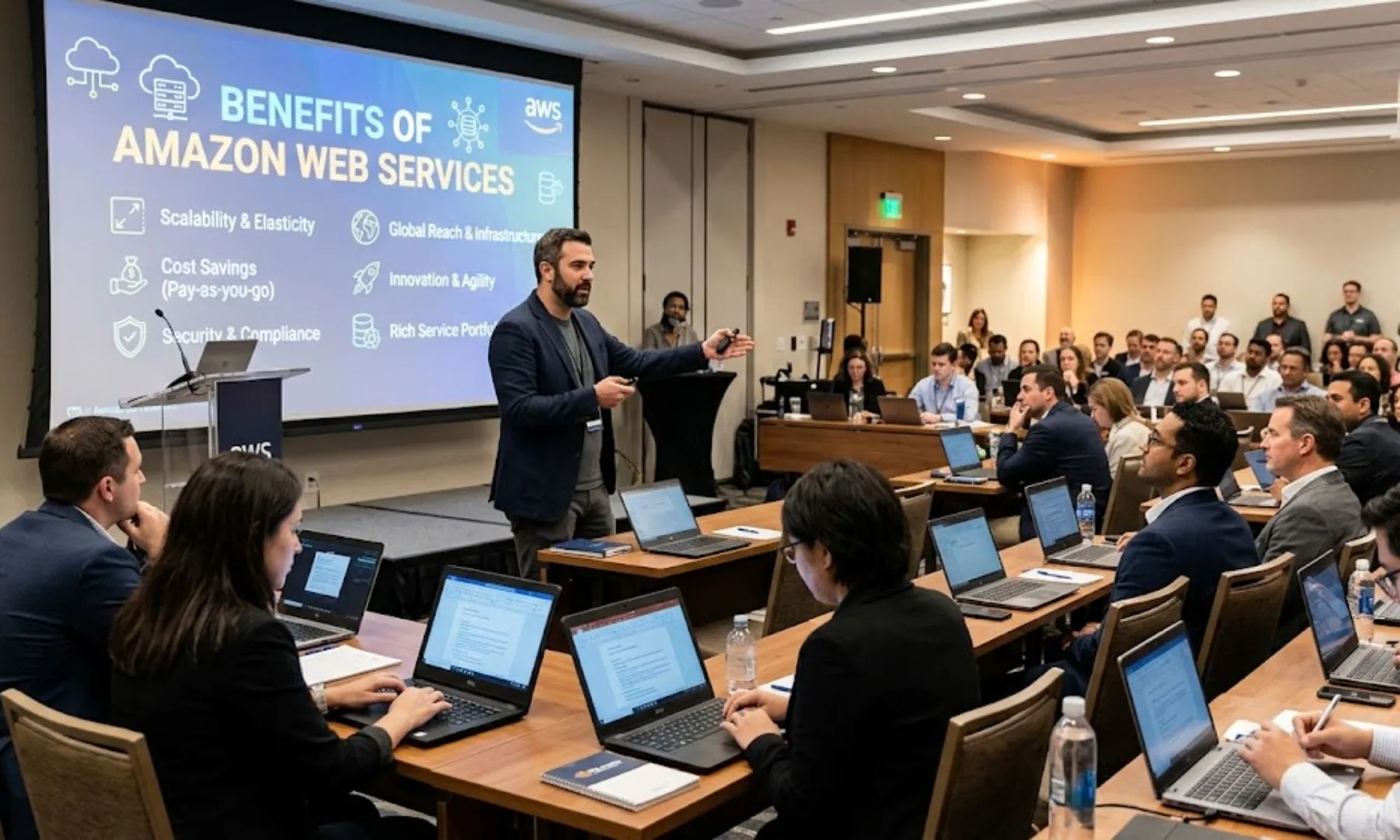
AWS Solutions for Startups, Small Businesses, and Enterprises
AWS supports organizations of different sizes. Companies can use AWS for websites, applications, storage, databases, analytics, and cloud migration.
AWS for Startups
AWS for startups provides flexible infrastructure for launching and scaling digital products.
AWS for Small Businesses
Small businesses can use AWS to host websites, store data, create backups, and run business applications.
AWS for Enterprises
AWS for enterprises supports large applications, security, analytics, application modernization, and global deployment.
AWS Use Cases Across Different Industries
AWS Healthcare, finance, retail, manufacturing, media, education, and technology all utilize AWS across healthcare, finance, retail, manufacturing, media, education, and technology.
AWS for Healthcare
Healthcare organizations can use AWS for applications, analytics, storage, and secure digital services.
AWS for Financial Services
Financial companies can use AWS for analytics, fraud detection, risk management, and customer applications.
AWS for Retail and E-Commerce
Retailers can use AWS to build cloud applications, manage product data, analyze customers, and handle high website traffic.
AWS Global Infrastructure
AWS global infrastructure allows applications to run in different geographic locations. This can improve performance and availability.
AWS Regions
AWS Regions are geographic areas containing AWS infrastructure. Businesses choose regions based on location, latency, compliance, and service availability.
AWS Availability Zones
Availability Zones are isolated locations within AWS Regions. Using multiple zones can improve application reliability.
AWS Security, Privacy, and Compliance
AWS provides security technologies for protecting applications, identities, networks, and data. The customer is still responsible for securing many parts of their AWS environment.
AWS Identity and Access Management (IAM)
IAM controls who can access AWS resources and what actions they can perform. Least-privilege access is an important security practice.
Data Encryption on AWS
Data encryption protects information from unauthorized access. AWS provides encryption options for stored and transmitted data.
Network Security
AWS network security includes VPCs, security groups, network controls, and firewalls. These tools help protect applications and private resources.
AWS Pricing and Free Tier
AWS Pricing depends on services, usage, resources, and location.
How AWS Pricing Works
AWS generally charges according to resource usage. Costs vary between services.
AWS Pay-As-You-Go Model
The Pay-as-you-go model lets customers pay for resources they use instead of buying large amounts of hardware upfront.
AWS Free Tier
The AWS Free Tier provides eligible free usage within specific limits. Users should monitor usage to avoid unexpected charges.
How to Reduce AWS Costs
AWS cost optimization includes removing unused resources, choosing suitable resource sizes, monitoring usage, and controlling budgets.
AWS Pricing Calculator
The AWS Pricing Calculator helps estimate the expected cost of an AWS architecture before deployment.
How to Get Started With AWS
Beginners should learn basic cloud concepts before moving to advanced AWS services.
How to Create an AWS Account
Create an AWS account, secure it with strong authentication, and learn the AWS Management Console.
Choosing Your First AWS Service
Start with Amazon EC2, Amazon S3, IAM, and VPC. These services provide a strong foundation.
AWS Learning Resources
Use AWS documentation, tutorials, training materials, and practical projects.
AWS Certifications
AWS certification can demonstrate your AWS knowledge. Practical experience should be developed alongside certification study.
Conclusion
Amazon Web Services (AWS) provides a powerful collection of cloud services for computing, storage, databases, networking, security, AI, and analytics.
For beginners, the best approach is to learn core services such as EC2, S3, IAM, VPC, and RDS, then gain practical experience through projects.
For businesses, AWS can support AWS cloud migration, application modernization, and digital transformation. With consistent practice and a clear AWS learning roadmap, AWS can become a valuable skill for modern IT and cloud careers.
FAQs
Is AWS an ERP system?
No. AWS is a cloud computing platform, not an ERP system. ERP software can run on AWS cloud infrastructure.
Can I learn AWS for free?
Yes. You can learn AWS for free through AWS documentation, tutorials, free learning resources, and eligible AWS Free Tier services.
Can I learn AWS in 3 months?
Yes. You can learn AWS fundamentals in 3 months with regular study and hands-on practice.
How much do AWS courses cost?
AWS course costs vary from free resources to paid courses. Official certification exams have separate fees.
Is AWS a high-paying job?
Yes. AWS-related cloud roles can be well-paid, especially for professionals with strong practical skills, experience, and relevant certifications.
Meta Descriptions
Learn Amazon Web Services (AWS), cloud computing, key AWS services, benefits, pricing, security, and how to start using AWS.
Responses
Join the conversation
Sign in to share your thoughts and interact with the author.
Sign In to Comment