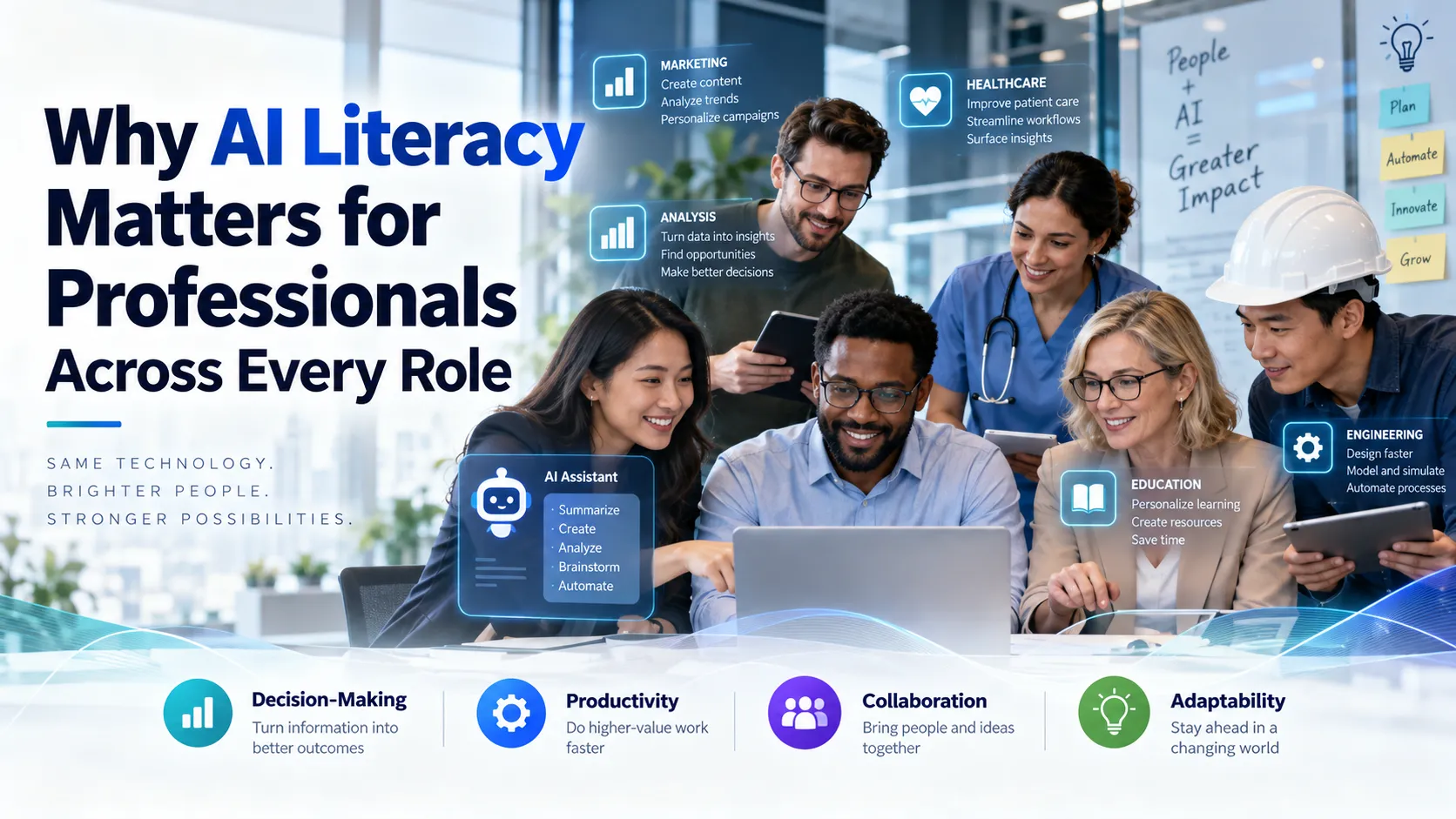
Artificial intelligence is becoming part of everyday work, whether employees are writing, analyzing data, planning projects, communicating with customers, or making decisions. That means AI literacy is no longer useful only for technical teams. It is becoming a practical skill for professionals across almost every role.
AI literacy does not mean knowing how to build machine learning models. It means understanding what AI can do, where it can go wrong, how to use it responsibly, and when human judgment still matters.
What AI Literacy Means in the Workplace
At a practical level, AI literacy combines understanding, use, and evaluation. Employees should know enough about AI to recognize its strengths and limitations. They should be able to give clear instructions and review outputs instead of assuming that a polished response is automatically correct.
As AI becomes part of normal digital work, these abilities increasingly sit alongside other professional skills covered through training courses. The goal is not to turn every employee into an AI specialist, but to help people use intelligent tools with better judgment.
AI Literacy Is Relevant in Every Department
A marketer may use AI to organize campaign ideas. An analyst may use it to explain patterns in data. HR teams may draft internal communications. Managers may summarize reports or prepare for meetings. IT teams may work with automation, troubleshooting, or AI-supported documentation.
Each role uses AI differently, but the same questions apply: Is the output accurate? Is the data appropriate to use? Does the task require human review? Is AI the right tool for the job?
Strong AI Literacy Starts With Knowing the Limits
One of the easiest mistakes to make with AI is confusing fluency with accuracy. Generative AI can produce responses that sound clear and confident even when details are missing or incorrect. Employees who understand this are more likely to verify important information instead of simply copying the first response.
AI literacy also means recognizing which tasks are suited to automation and which depend heavily on judgment. Drafting a meeting summary may carry little risk. Interpreting financial figures, handling sensitive employee information, or making decisions that affect customers requires more care.
Better AI Use Can Improve Daily Productivity
AI literacy can make routine work more efficient because employees know how to use the technology with purpose.
Instead of asking a vague question, an AI-literate employee can explain the goal, audience, constraints, and expected format. That usually produces a more useful first result and reduces time spent correcting misunderstandings.
Broader certification paths can build deeper subject knowledge, while AI literacy helps employees decide how intelligent tools fit into work they already understand.
Critical Thinking Becomes More Important, Not Less
AI does not reduce the need for critical thinking. In many situations, it increases it.
Employees need to judge whether a response makes sense, compare it with reliable information, and recognize when something feels incomplete. A simple review habit can help:
- Check important facts, figures, and sources.
- Look for missing context or assumptions.
- Consider whether bias could affect the result.
- Decide whether deeper expertise is needed.
These steps turn AI from a source of automatic answers into a tool that supports better work.
Responsible AI Use Includes Privacy and Data Awareness
AI literacy is also about knowing what information should and should not be shared with an AI system. Employees may work with customer records, internal plans, financial information, employee data, or confidential documents. Copying sensitive material into the wrong tool can create unnecessary risk.
Professionals need to understand their organization’s rules, the permissions of the tools they use, and the difference between approved business systems and public AI services. When AI is introduced across teams, privacy, verification, and shared usage standards can become part of group training so employees follow more consistent practices.
AI Literacy Helps Technical and Nontechnical Teams Work Together
AI projects often involve people with different backgrounds. Technical teams may understand models and systems, while business teams understand customers, operations, compliance, or department-specific goals.
AI literacy gives those groups a common language. A nontechnical employee does not need to understand every technical detail to explain a business problem clearly, question an AI-supported recommendation, or describe the result they need.
Different Roles Need Different Levels of AI Knowledge
Not everyone in an organization needs the same level of AI expertise. A general office user may need to understand prompting, verification, privacy, and responsible use. A manager may also need to think about workflow changes and accountability. Technical professionals may need deeper knowledge of automation, security, or implementation.
This is why AI literacy works best as a progression rather than a one-size-fits-all skill. AI-related subjects now appear alongside established workplace technologies in many class schedules, reflecting how digital learning is becoming more role-specific.
AI Literacy Supports Better Adaptation to Change
AI tools are changing quickly, and today's advanced features may soon become standard workplace tools.
Employees who understand basic AI principles are better prepared because they are learning how to evaluate new tools, ask better questions, recognize risks, and adapt their workflows.
That makes AI literacy less about mastering one platform and more about building a durable way of working with intelligent systems.
AI Literacy Is Becoming Part of Professional Readiness
Professionals do not need to become AI engineers to work effectively in an AI-enabled workplace. They do need enough understanding to use the technology thoughtfully.
That means knowing how to interact with AI, evaluate what it produces, protect sensitive information, and decide when human judgment should take over.
As AI becomes more deeply connected with daily work, those habits will matter across departments and job levels. AI literacy is ultimately about using powerful tools without giving up responsibility, context, or critical thinking.
Responses
Join the conversation
Sign in to share your thoughts and interact with the author.
Sign In to Comment