Artificial intelligence has transformed the way businesses operate. From generating content and analyzing data to answering customer queries and automating repetitive tasks, AI has become part of everyday business operations.
However, many organizations are facing a new challenge.
The issue is no longer adopting a single AI tool.
It is managing many of them.
Marketing teams use one platform for content creation. Sales teams rely on another for lead generation. Human Resources uses AI for recruitment, while operations depend on workflow automation. Each department often selects different AI applications based on its own requirements.
Although these tools improve individual tasks, they frequently operate independently. As a result, organizations spend significant time switching between applications, coordinating workflows manually, and maintaining multiple subscriptions.
Instead of simplifying operations, disconnected AI systems can introduce additional complexity.
The Next Evolution of Enterprise AI
The next stage of enterprise AI is not simply deploying another chatbot or productivity application.
It is creating an AI workforce.
An AI workforce consists of specialized AI assistants, production agents, and workflow automation working together within a unified environment. Rather than replacing employees, these systems automate repetitive work and support teams in completing business processes more efficiently.
This approach changes AI from an individual productivity tool into an operational capability that supports the organization as a whole.
A Unified AI Workforce Platform
OllaSuper is an AI Workforce Platform designed to coordinate AI assistants, production agents, and intelligent workflows from a single workspace.
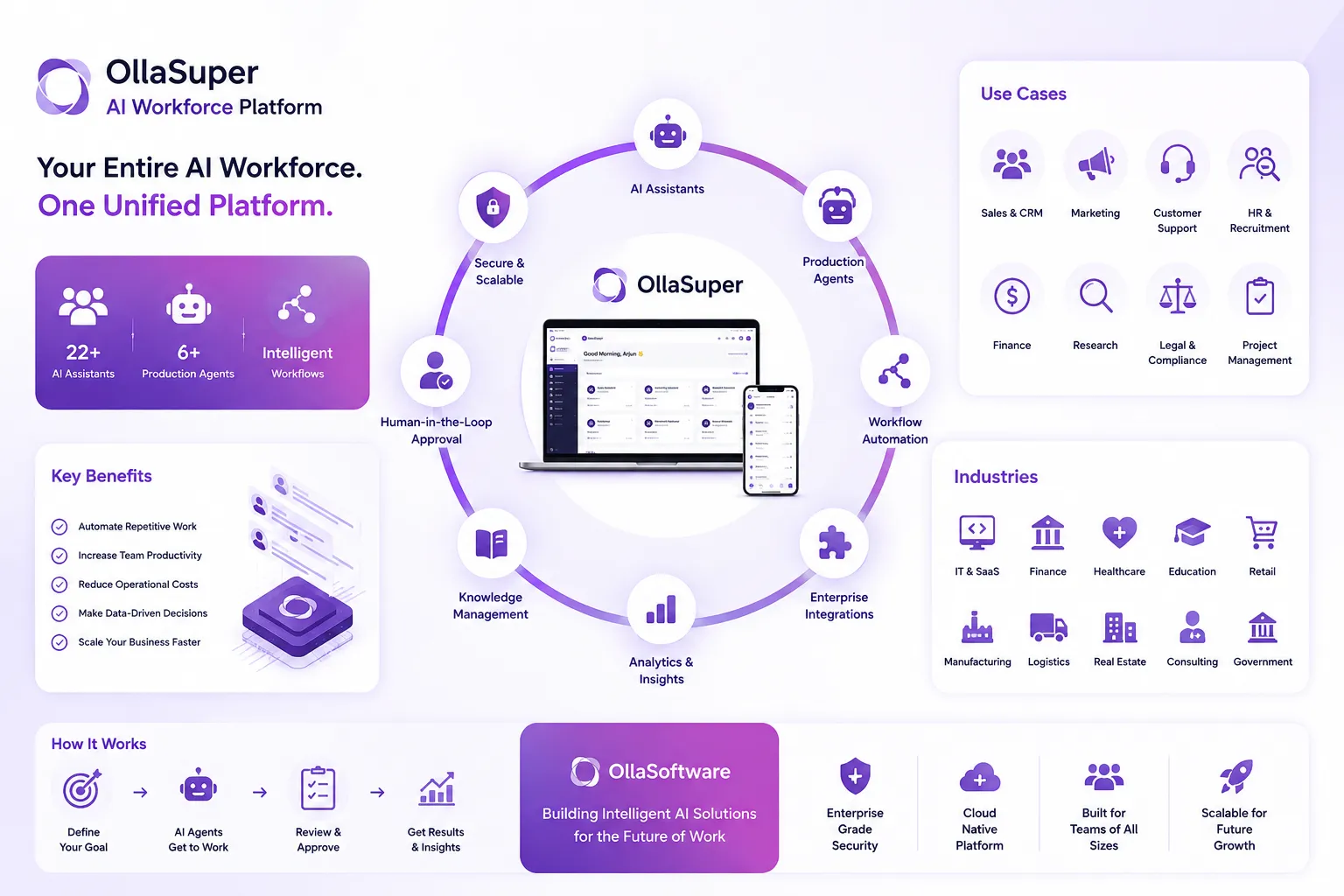
Instead of managing multiple AI applications independently, organizations can centralize AI-powered business operations within one platform.
The platform includes:
- 22 specialized AI Assistants
- 6 Production Agents
- Intelligent workflow automation
- A unified workspace for enterprise AI operations
This architecture allows organizations to coordinate AI activities through a single environment rather than managing disconnected solutions.
Supporting Multiple Business Functions
Most organizations share a common challenge regardless of department: repetitive and manual work.
An AI workforce can support several business functions.
Sales and CRM
AI can assist with prospect research, lead qualification, customer information management, and sales preparation.
Marketing
Marketing teams can automate content generation, campaign planning, keyword research, and SEO activities while maintaining consistency.
Human Resources
AI can support resume screening, candidate communication, onboarding, and administrative workflows.
Customer Support
Customer requests can be categorized, summarized, and routed automatically to improve response efficiency.
Finance and Operations
Routine reporting, documentation, and operational processes can be streamlined through workflow automation.
Knowledge Management
Organizations can centralize internal knowledge, making information easier to organize and retrieve.
From Individual Tasks to Complete Workflows
Many AI applications automate individual activities.
An AI workforce focuses on complete business workflows.
For example, a business process may include:
- Receiving a request
- Selecting the appropriate AI assistant
- Executing the required action through a production agent
- Requesting human approval when necessary
- Delivering the completed result automatically
Rather than optimizing isolated tasks, workflow orchestration improves the overall business process.
Why Organizations Need an AI Workforce
As businesses expand, managing multiple AI applications becomes increasingly difficult.
Different departments depend on different software, data sources, and operational processes.
Without coordination, organizations often spend more effort managing technology than benefiting from it.
A unified AI workforce provides:
- Centralized AI operations
- Collaboration between specialized AI assistants
- Workflow automation across departments
- Enterprise scalability
- Human oversight for critical decisions
- Improved operational visibility
This approach reduces fragmentation and simplifies enterprise AI management.
Designed for Enterprise Automation
Organizations require AI systems that integrate naturally with existing business processes.
A unified AI workforce enables businesses to automate repetitive work, improve collaboration, and streamline operations while maintaining human involvement where appropriate.
Instead of replacing employees, AI supports them by reducing administrative effort and improving operational efficiency.
Looking Ahead
For many years, organizations addressed operational challenges by introducing additional software.
Enterprise AI introduces a different opportunity.
Rather than adding another independent application, businesses can coordinate specialized AI assistants, production agents, and workflow automation within a unified platform.
As enterprise AI continues to evolve, organizations may benefit more from connected AI systems than from isolated productivity tools.
Understanding how to coordinate AI effectively may become one of the defining challenges of modern enterprise software.
References
OllaSuper Product Information
Responses
Join the conversation
Sign in to share your thoughts and interact with the author.
Sign In to Comment