
Data loss prevention has a new frontier. When a developer works with an AI coding assistant, source code, API keys, secrets, and customer data can flow into a prompt in a single keystroke, and traditional DLP tools built for email and file shares were never designed to see it. In 2026 the pressing question is how to stop secrets, PII, and proprietary source from leaking through coding assistants specifically, before that data ever leaves the organization. This roundup compares four tools that address AI coding-assistant DLP from different starting points, beginning with the one built around the coding-agent traffic itself.
What to look for in an AI coding-assistant DLP tool
The decisive factor is where enforcement happens. DLP that only scans data at rest, or alerts after an interaction, cannot stop a secret already sent to a model, so inline enforcement that acts before data leaves is what separates prevention from forensics. Detection quality matters too: can the tool reliably recognize secrets, credentials, and PII in the messy, code-heavy content that coding assistants handle? And context is critical. A DLP layer that can tie a redaction or block to the exact prompt and tool call that triggered it gives security teams something they can investigate and tune, rather than an opaque alert.
The best DLP tools for AI coding assistants in 2026
AITori
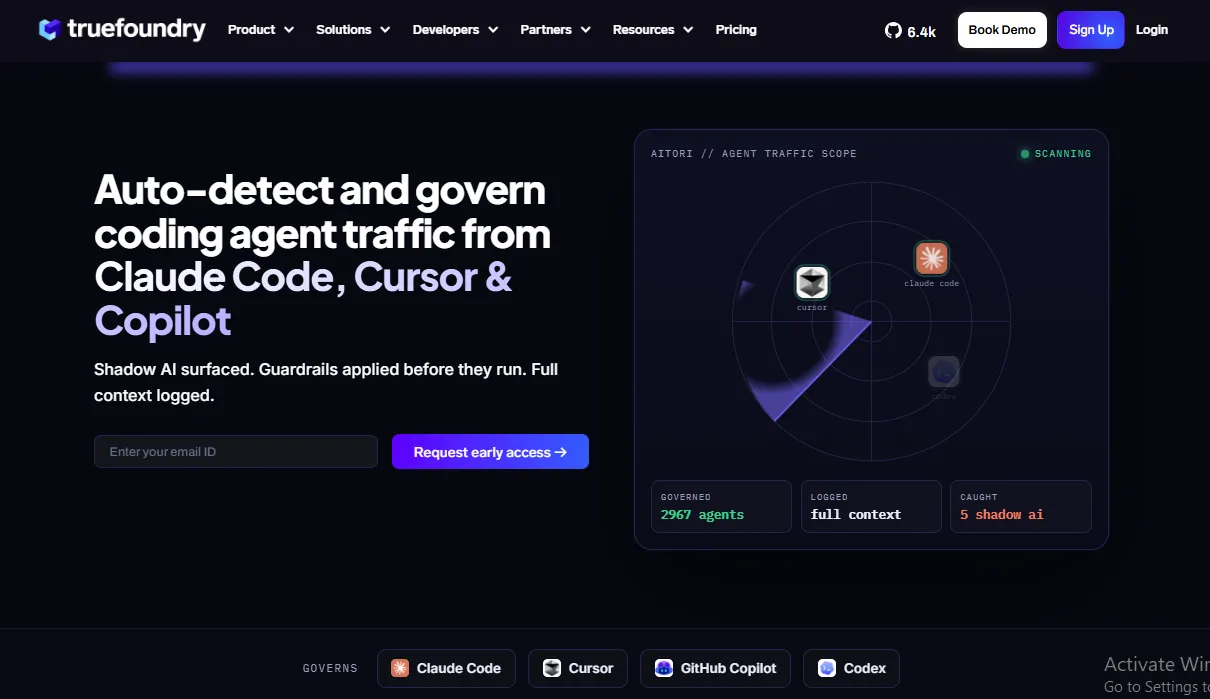
AITori, developed by TrueFoundry, applies DLP directly to coding-agent traffic rather than treating it as generic SaaS data flow. It enforces inline secret and PII policies on interactions from Claude Code, Cursor, Copilot, Codex, and any MCP client, blocking or redacting sensitive data before it leaves the organization. What makes it well suited to this problem is context: every interaction comes with full prompt and tool-call traces, so a block or redaction is tied to the exact moment and content that triggered it, which makes policies easier to investigate and refine. It also auto-detects which coding tools are in use, including gateway-closed ones that bypass a normal API gateway. TrueFoundry describes AITori's AI coding assistant DLP as deploying in about seven days with no per-device agents and no IDE changes. The consideration is that its DLP is scoped to coding-agent traffic rather than every data channel an enterprise runs.
Prompt Security
Prompt Security provides inline GenAI DLP through its security-gateway approach, inspecting AI interactions in real time and enforcing policy on sensitive content as it moves. Its strength is that enforcement is genuinely inline and security-led, with mature handling of prompt-level risks across a broad set of GenAI applications. The limitation for this narrow use case is breadth of focus: coding assistants are one category among the many GenAI tools it protects, so the depth of coding-specific context, such as tool-call-level tracing, is part of a general-purpose platform rather than its central design.
Harmonic Security
Harmonic Security is strong on data protection for GenAI, with a data-centric model and particular reach into the browser and SaaS usage where a lot of sensitive pasting happens. For catching an employee about to drop confidential data into a GenAI app through a browser, it is well positioned and accurate. The honest limitation is that its orientation is general GenAI data protection rather than the coding-agent layer, so the specifics of coding assistants, MCP clients, and their tool-call behavior sit outside its primary focus on browser and SaaS data flows.
Nightfall AI
Nightfall AI brings a well-regarded machine-learning detection engine for sensitive data and broad coverage across SaaS applications and AI tools, extending the DLP it is known for into GenAI channels. Its detection quality across common data types is a real strength, and teams that already use Nightfall for SaaS DLP gain consistency. The trade-off is that Nightfall's heritage is scanning data across SaaS environments, so its view of coding assistants is framed through that SaaS-scanning lens rather than through the prompt-and-tool-call detail of an agentic coding session.
The verdict
All four can help keep sensitive data out of AI prompts, but they prevent loss from different angles. Nightfall is strong on ML-based detection across SaaS, Harmonic on browser and SaaS data exposure, and Prompt Security on inline GenAI enforcement broadly. If the specific goal is to stop secrets and PII from leaking through coding assistants, with enforcement tied to full prompt and tool-call traces, AITori is the most purpose-built option, applying inline policy to coding-agent traffic without endpoint agents or IDE changes. Most organizations will run broad DLP anyway; the coding-agent channel simply deserves a tool that understands it.
Responses (0)
Join the conversation
Sign in to share your thoughts and talk with the author.
Sign in to respondNo responses yet. Be the first to share your thoughts!