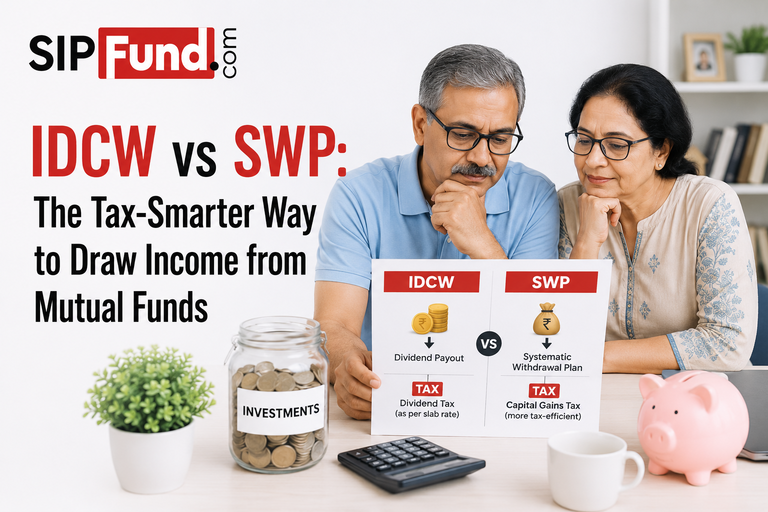
Many Indian investors who are approaching retirement or who have built a sizable corpus look for options to get a regular income from their investments.
They are aware of the Dividend option, also known as IDCW (Income Distribution cum Capital Withdrawal), and was previously marketed in India as the income-generation route from mutual funds, as opposed to the other Growth option that did not generate such income. But there is a lesser-known third choice: the Growth option with SWP setup.
With the Growth option and a Systematic Withdrawal Plan (SWP), investors can pay themselves a monthly income by selling a portion of their portfolio.
A comparison between the two income-generating strategies can help investors avoid unknown pitfalls or outcomes that they may regret later. The comparison will be judged using 4 testing criteria: impact on tax, control over income, control over portfolio longevity, and investor comfort.
Option A: Generating Income Through IDCW (Dividend Payouts)
In the Dividend option, the payout to the investor is obtained from the difference in the NAV of the mutual fund unit. If a fund house declares a ₹2 dividend on each fund unit, the NAV decreases from ₹100 to ₹98 after the payout. The number of fund units with the investor does not change.
Tax Impact:
Payout Taxed as Investor’s Income — Since there is no redemption of fund units, the dividend from mutual funds is considered an income that is taxed at the investor’s applicable income slab (Tax slabs defined in Section 25, Finance Act 2025, amendment of Section 115BAC, Income Tax Act 1961).
As an illustration, if a single dividend paid in a year is ₹20,000, then this entire amount is taxable. This investor with an existing annual income of ₹9 lakh will be taxed at the 10% tax slab rate. The taxes from this payout would total ₹2,000, and the net payout will be ₹18,000.
This deducted tax may seem too much to many investors, especially those earning in a higher tax bracket.
Also, a 10% TDS is applicable on the income if the dividend exceeds ₹5,000 a year, under Section 194K, Income Tax Act 1961. The investor receiving ₹20,000 as dividend will directly receive the reduced amount of ₹18,000 in their bank account from their AMC.
Investor’s Control over Taxable Events — The investor has no control over when the dividend is paid out by the mutual fund house (AMC), and the resulting taxes are incurred.
For many investors, this lack of control over the timing and amount of tax deduction can be an inconvenience they do not want to experience.
Ease of Tax Estimation — Tax under the dividend option is extremely easy for investors to compute, as it involves only the standard income tax slab calculations.
Control Over Your Income:
Control on Payout Amount, Frequency & Start Date — The investor does not have any control over the dividend amount, how often it will be paid, or the timing of the first payment after choosing the IDCW option for that fund; all these are solely decided by the fund house (AMC).
This is especially inconvenient to investors who need a consistent monthly income, either for their daily needs or for important financial goals.
Payout Predictability — With the payout conditions being completely out of the investor’s control, it becomes difficult for them to arrive at any consistent amount, around which they can reliably plan their dependent life needs and goals.
Control over Modifications in Payout Conditions — Since the payout conditions are decided by the fund houses, the investor gets no provision of modifying the payout amount or its frequency.
Impact on Portfolio Longevity:
Estimation of Portfolio Longevity — Investors without prior knowledge of the dividend amount or the payout frequency are essentially blind to future costs that can reduce their investment corpus. So, there is no way for investors to estimate how long their portfolio will last.
Investors who are planning for a retirement income may find the dividend income unreliable.
Investor Comfort & Behavior:
Comfort with Dividend option — Many investors may feel a subconscious aversion to redeeming fund units, which leaves the dividend option as the acceptable choice.
Ease of Maintaining Payout — Payout under the dividend option is decided solely by the fund house, and the investor has to expend no effort in maintaining it.
Option B: Generating Income Through a Growth Fund and SWP
If the investor sets up an SWP under the Growth option, then the payout is generated through the sale of a fraction of mutual fund units from the investor’s portfolio. The number of units decreases, but their NAV remains the same.
Tax Impact:
Payout Taxed as Capital Gains — The payout withdrawn is treated as a combination of the original investment and accrued capital gains. The tax is applied solely to the gain portion of the total payout. The exact percentage of tax on the taxable amount depends on the type of mutual fund unit: equity, debt, hybrid.
The tax on gains from equity mutual funds depends on their holding period. The tax on short-term capital gains (STCG), from funds with a holding period of less than 1 year, is 20% (Clause 1(i)(b), Section 111A, Income Tax Act 1961). The tax on long-term capital gains (LTCG), for funds with holding periods greater than a year, is 12.5%. But if the annual aggregate of the long-term gains is below ₹1,25,000, no tax is applicable (Clause 2(b), Section 112A, Income Tax Act 1961).
Gains from debt mutual funds are taxed as income, which follows the income tax slabs, as laid out in Section 25, Finance Act 2025, the amendment of Section 115BAC, Income Tax Act 1961.
Gains from hybrid funds have a more complex tax treatment depending on their underlying asset allocation. Gains from hybrid funds with more than 65% exposure to domestic equities, defined in Clause 6(a)(ii), Section 112A, Income Tax Act 1961, are taxed under the equity mutual fund regime depending on the holding period (STCG or LTCG). If these are debt-oriented funds with more than 65% exposure to domestic debt and money market instruments, defined in Explanation (ii) “Specified Mutual Funds” (a), Section 50AA, Income Tax Act 1961, then their gains are taxed as short-term capital gains at the investor's applicable slab rate. Investors should check the fund's equity allocation rather than relying solely on its category name.
For illustration, suppose an investor withdraws ₹20,000 every month. His original investment of ₹10 lakh has grown to ₹12 lakh. His capital gains total ₹2 lakh, and the gains percentage is 16.67% of his current portfolio value. This same percentage is applicable to find the taxable amount in the withdrawal. On a withdrawn amount of ₹20,000, only ₹3,334 is taxable. Also, the annual taxable gains total ₹40,008, which is below the ₹1.25 lakh limit. That reduces the final taxable amount to ₹0.
This is a huge point in favour of choosing a growth fund with SWPs.
Redemptions by resident individual investors aren't subject to TDS. Investors can pay the applicable tax during filing.
Investor’s Control over Taxable Events — The investor has full control over when the payout happens, and so they also control when the taxes are deducted from their investment corpus.
Ease of Tax Estimation — The complex rules governing the tax treatment can be confusing to many investors, which can be a valid deterrent to their use.
Control Over Your Income:
Control over Payout Amount, Frequency & Start Date — The investor enjoys full control over when they want to start the SWP to their bank account, how much they want per month, and how often they need the payments. These decisions can be made based on their lifestyle needs and portfolio limits. Also, the SWP needs to be set up only once, and the monthly payments will continue till the investor stops it.
One point of caution: The monthly payouts need to be less than the growth of the portfolio; otherwise, the fund can simply dry out.
Payout Predictability — Since the investor chooses the payout frequency, the entire setup is completely predictable, which works in favor of the investor and helps their financial planning.
Control over Modifications in Payout Conditions — The investor is free to choose any modifications they want in the SWP payout structure. They can pause, increase the payout amount, or stop it altogether.
Impact on Portfolio Longevity:
Estimation of Portfolio Longevity — Since the investor controls the payout conditions, they also can estimate with certainty how long their portfolio will last.
Investor Comfort & Behavior:
Discomfort with Fund Redemptions — Many investors are wary of selling any fund units. This is an unconscious bias that can prevent them from choosing the growth option with SWP.
Ease of Maintaining Payout — Managing a monthly payout that does not empty the investment corpus needs consistent time and effort with expert guidance. This process can be complex for many investors.
Side-by-Side Comparison of IDCW and SWP
The final payout that an investor receives from the dividend option vs the growth option with SWP (Systematic Withdrawal Plan) is wildly different.
Let us assume the investor who started their investment with ₹10 lakh has grown it to ₹12 lakh today. They have 16.67% of their current portfolio value (₹2 lakh) as gains. In situations where the tax slab is applicable, this gain will be considered as income. If the existing annual income is ₹9 lakh, the total income falls under the tax slab of 10%.
Investors can find themselves in 4 types of tax situations when withdrawing income from their mutual funds, based on their choices. It can be a:
- dividend payout
- SWP payout from a growth equity fund held long-term
- SWP payout from a growth equity fund held short-term
- SWP payout from a debt fund
Dividend payout</th><th>Option B:
Growth+SWP payout, Equity funds, LTCG</th><th>Option C:
Growth+SWP payout, Equity funds, STCG</th><th>Option D:
Growth+SWP payout, Debt funds</th></tr></thead><tbody><tr><td>Income Withdrawn</td><td>₹20,000</td><td>₹20,000</td><td>₹20,000</td><td>₹20,000</td></tr><tr><td>Taxable Amount</td><td>₹20,000</td><td>₹3,334
(16.67% of withdrawn)</td><td>₹3,334
(16.67% of withdrawn)</td><td>₹3,334
(16.67% of withdrawn)</td></tr><tr><td>Tax rate</td><td>10% (tax slab)</td><td>12.5%</td><td>20%</td><td>10% (tax slab)</td></tr><tr><td>Annual Total of Taxable Amount</td><td>₹20,000</td><td>₹40,008</td><td>₹40,008</td><td>₹40,008</td></tr><tr><td>Revised Tax rate</td><td>NA</td><td>0%</td><td>NA</td><td>NA</td></tr><tr><td>Tax</td><td>₹2,000</td><td>₹0</td><td>₹666.80</td><td>₹333.40</td></tr><tr><td>Actual Income</td><td>₹18,000</td><td>₹20,000</td><td>₹19,333.20</td><td>₹19,666.60</td></tr></tbody></table>
Payouts from both the dividend option (IDCW) and SWP from a growth debt fund are taxed using the income tax slabs. The dividend option considers the entire withdrawal as taxable, whereas only the gains fraction of the withdrawal from a growth debt fund is taxable. The resulting lower tax is a huge advantage in favor of using SWPs with a growth debt mutual fund.
For the SWP payouts from equity funds, only the gains portion of the withdrawal is the taxable amount, same as for debt mutual funds. The holding period next decides the tax rate, between 12.5% and 20%. Finally, if the total annual taxable amount obtained from that fund is below ₹1.25 lakh, the tax rate drops to 0%, applicable only to the gains from long-term held equity funds.
So an investor holding equity funds for many years can effectively set up a consistent monthly income using an SWP (Systematic Withdrawal Plan), make sure the aggregate annual taxable income stays below the threshold of ₹1.25 lakh, and pay no tax at all.
Also, TDS is applicable for the dividend payout option only. Investors with this payout structure will have taxes deducted at the time of withdrawal, and receive only ₹18,000 (for this example). Other investors getting payouts from redemption of their growth fund units can pay the taxes late during filing.
Next, investors can use 4 testing factors to compare the general usability of the two payout options. From the comparison, we see that these options cater to two different types of investors.
The Systematic Withdrawal Plan (SWP) on a Growth fund works better for investors who:
- Need a fixed monthly income
- Want greater tax efficiency
- Want control over withdrawals
- Want to manage portfolio sustainability
Conversely, the dividend option is better suited to investors who:
- Are uncomfortable redeeming units
- Don't need regular income
- Don’t want to handle complicated tax and portfolio calculations
Not Sure How Much You Can Safely Withdraw? SIPfund Can Help
Some investors would choose the dividend (IDCW) option for its simplicity and familiarity. For other investors, a growth fund with SWP gives them greater control and tax efficiency. However, it requires a withdrawal strategy that is sustainable for their corpus size, income needs, and investment horizon.
SIPfund’s team can help determine a suitable withdrawal rate for you, based on your timeline and risk comfort. You can get a withdrawal plan set up at different stages of your investment journey, so you never run the risk of over-withdrawing and compromising your long-term financial goals.
Whatever your final choice of payout structure may be, the SIPfund app gives you access to the investments needed to implement your decision from a single account. There is no need to maintain multiple investment relationships or navigate different platforms. You can research, invest, and review your portfolio in one place.
What Next?
Start your SIP with the SIPfund App (iOS or Android), pick a Growth fund, set up your SWP, and enjoy a monthly income from your hard-earned money.
Also, get your safe Withdrawal Rate from Our Team at 95133 55661 in 60 minutes, or contact us on WhatsApp.
<i>Disclaimer: The information provided in this article is for educational purposes only and does not constitute investment advice or a recommendation to buy or sell any mutual fund. Mutual Fund investments are subject to market risks; read all scheme-related documents carefully.</i>
Responses
Join the conversation
Sign in to share your thoughts and interact with the author.
Sign In to Comment