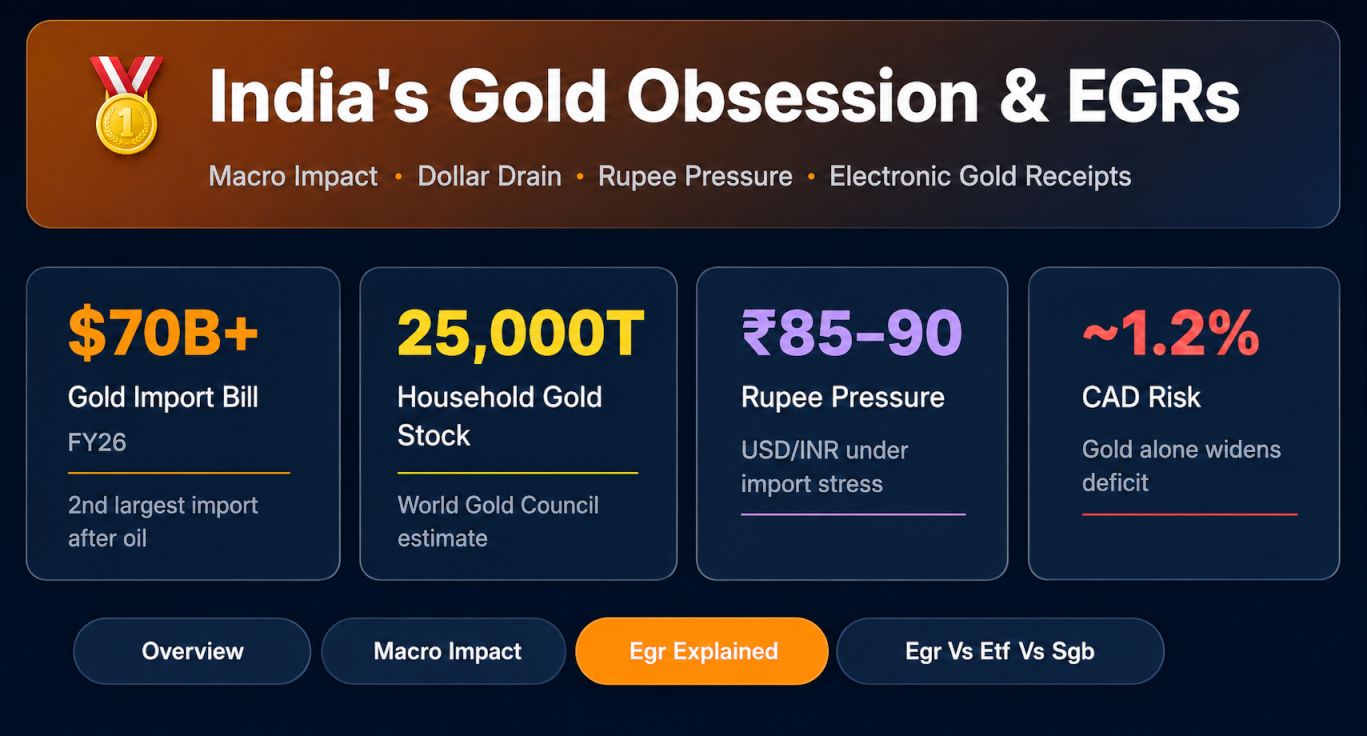
India's Obsession with Gold & EGRs
What the obsession means
$70B+ Gold Import Bill FY26, 2nd largest import after oil
25,000T Household Gold Stock, World Gold Council estimate
₹85–90 Rupee Pressure, USD/INR under import stress
~1.2% CAD Risk, Gold alone widens deficit
A. Overview
💛 India's Complicated Love Affair with Gold
Gold in India is not merely an investment instrument— it’s a symbol of prosperity, a wedding necessity, and generational wealth. India and China together account for nearly 50% of global gold demand. In FY26 alone, India's gold import bill crossed $70 billion, making gold the second-largest import after crude oil.
The World Gold Council estimated that Indian households hold up to 25,000 tonnes of gold — worth over $2 trillion — much of it locked in lockers, temples, and family vaults, completely outside the formal financial system. This hoarding mindset means capital that could fund productive economic activity instead sits idle in hidden physical form.
Prime Minister Modi's appeal to citizens to restrict non-essential gold purchases, combined with raised import duties on gold and silver, signals that gold drags on India import and hence currency. Against this backdrop, Electronic Gold Receipts (EGRs), recently launched on NSE, represents a structural attempt to redirect this gold obsession into the formal economy.
B. Macro-Impact
How Gold Imports Hurt the Indian Economy
India's appetite for gold creates a cascading chain of macroeconomic stress that touches the dollar, oil, rupee, and growth simultaneously:
1. The Dollar Drain: Every dollar spent importing gold means dollar leaves India's forex reserves. At $70B+ annual gold import alone accounts for a massive chunk of India's import bill. This structural dollar outflow puts persistent downward pressure on the rupee. A weaker rupee, in turn, makes every subsequent import, especially oil, more expensive in rupee terms, creating a self-reinforcing spiral of currency depreciation.
2. The Oil-Gold Double Burden: India's two biggest import categories crude oil (~$130B+) and gold (~$70B) together account for nearly 40% of total imports. Both are dollar-denominated, both are largely price-inelastic (Indians won't stop buying gold at weddings; factories won't stop using oil), and both surge simultaneously during global uncertainty. When geopolitical tensions rise (like the Iran–Israel conflict), oil prices spike and gold demand also rises as a safe haven, hitting India from both sides at once.
3. Current Account Deficit (CAD) Widening: Gold imports directly widen India's Current Account Deficit. Economists estimate that gold alone contributes roughly 0.8–1.2% of GDP to the CAD in high-import years. A CAD above 2.5–3% of GDP triggers FII outflows, rating agency scrutiny, and further rupee weakness.
4. Forex Reserve Erosion: RBI uses forex reserves to defend the rupee. Heavy gold imports deplete these reserves faster, reducing India's buffer against external shocks. With reserves already under pressure from FII outflows and dollar strength, gold imports shrink India's defensive cushion at precisely the wrong time.
5. Idle Capital, Lost Growth: The 25,000 tonnes sitting in Indian households represents over $2 trillion in frozen capital. If even a fraction were monetised or channelled into productive investments, it could fund infrastructure, startups, or financial markets. Instead, it generates no yield, no tax revenue, and no economic multiplier, it simply sits, depreciating in economic utility while appreciating in price.
6. Inflation Feedback Loop: Rupee depreciation caused by gold and oil imports raises the cost of all dollar-priced imports, feeding into retail inflation. This forces the RBI into a tighter monetary stance, raising interest rates, which slows credit growth, dampens consumption, and ultimately drags on GDP — all traceable back, in part, to gold hoarding.
C. EGR explained
What Are Electronic Gold Receipts (EGRs)?
An Electronic Gold Receipt (EGR) is a SEBI-regulated instrument issued against physical gold deposited with a registered vault manager. The gold is stored securely, and the depositor receives an electronic receipt in demat form, tradeable on stock exchanges just like a share.
NSE's recent launch of EGR trading gives the instrument access to a wide network of brokers, exchanges, and retail investors, potentially making it the most accessible regulated gold product yet.
⚙️ How EGRs Work
Step 1 — Deposit: Eligible physical gold (hallmarked, of defined purity) is deposited with a SEBI-registered vault manager.
Step 2 — Receipt Issued: The vault manager issues an EGR in your demat account, representing ownership of that specific quantity of gold in the vault.
Step 3 — Trade: You can buy or sell EGRs on the exchange during market hours, just like stocks. Price reflects live domestic gold rates.
Step 4 — Pledge: EGRs can be pledged or hypothecated as collateral for loans, giving gold holders liquidity without selling their gold.
Step 5 — Redemption: At any point, you can convert your EGR back into physical gold, delivered from the vault.
🎯 Why EGRs Matter for India's Gold Problem
EGRs are a structural policy tool, not just a new product. By bringing gold trading into a regulated, transparent, demat-based system, they aim to:
Reduce demand for fresh gold imports by recycling existing domestic gold stocks
Bring the 25,000-tonne household hoard into the formal economy
Create a price-efficient, auditable market replacing fragmented jeweller/bullion dealer networks
Allow gold to be used as financial collateral, unlocking liquidity without actual import demand
Reduce smuggling and grey market gold transactions by making formal ownership simpler
D. EGR vs Gold ETF vs Sovereign Gold Bond
All three let you own gold digitally — but they're very different instruments
EGRs suit those who want exchange-traded gold with the option to take physical delivery. Ideal for bullion traders, jewellers, and investors who distrust paper gold. Gold ETFs remain the go-to for SIP investors seeking low-cost, liquid exposure. SGBs are the best long-term wealth instrument — capital appreciation plus 2.5% interest, tax-free at maturity — but require patience and have limited secondary liquidity. For India's macro health, EGRs hold the most structural promise: they can absorb existing domestic gold into the formal system without generating a single dollar of new import demand.
EGRs also complement the government's demand-side measures — including Prime Minister Modi's appeal to citizens to restrict non-essential gold purchases. While such appeals address the symptom, EGRs tackle the structure: by making existing domestic gold tradeable and liquid, they reduce the need to import fresh gold in the first place. If even 10% of the 25,000-tonne household stock enters the EGR system, it could meaningfully ease pressure on the rupee, narrow the CAD, and give RBI more room to focus on growth rather than currency defence.
Responses
Join the conversation
Sign in to share your thoughts and interact with the author.
Sign In to Comment