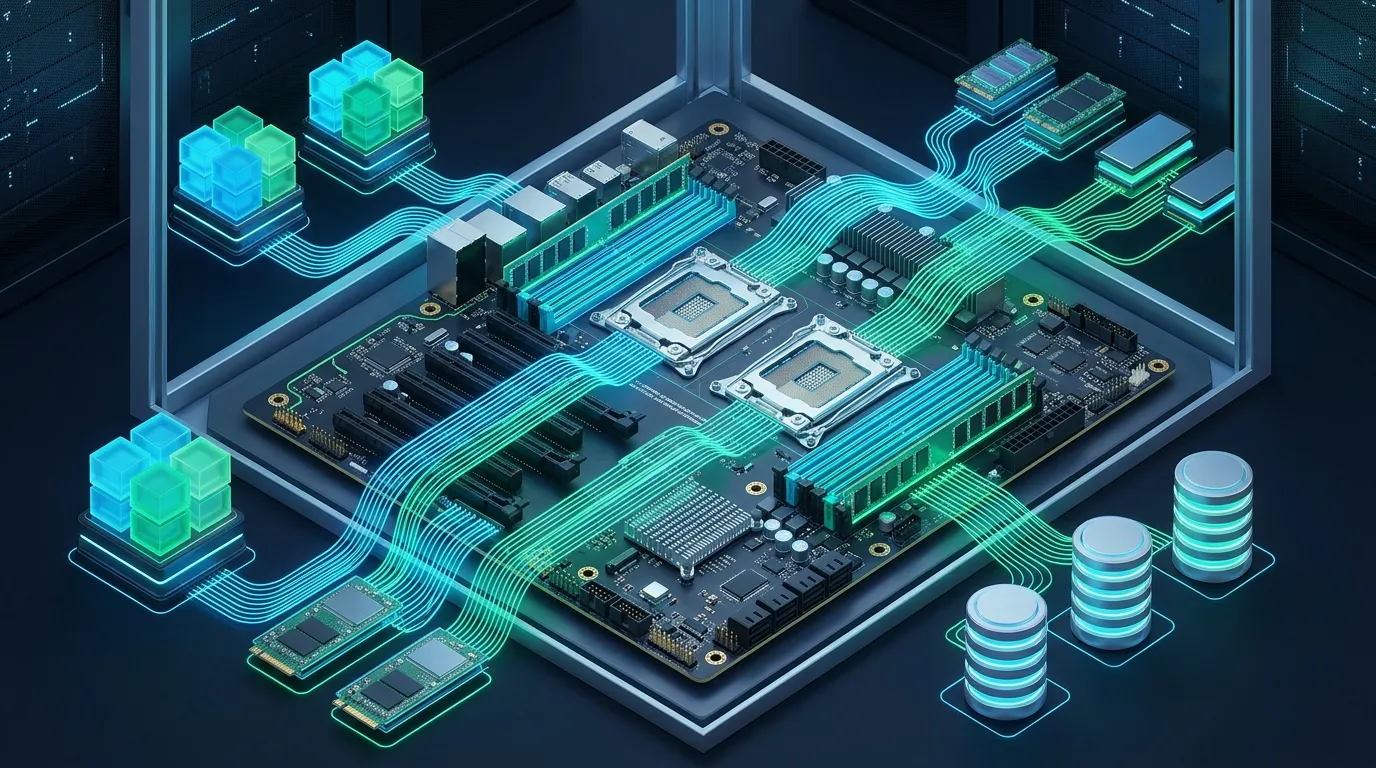

High-concurrency enterprise databases and multi-tenant hypervisors often run faster and more predictably on Intel Xeon servers than on consumer-derived chips, even when Xeon clock speeds look lower on paper. Once a host reaches heavy thread saturation across dozens of simultaneous workers, system throughput stops depending on how fast one instruction completes in isolation. Performance shifts instead toward parallel memory bandwidth, direct expansion lanes, and balanced memory access across sockets.
Measuring multi-core performance on Intel Xeon VPS virtualization platforms clarifies why server-class silicon still wins in heavily loaded multi-tenant environments. Objective Xeon Scalable benchmarks reflect engineering tradeoffs seen across enterprise datacenter deployments: desktop-derived Ryzen chips dominate low-concurrency single-thread latency, whereas Xeon servers protect steady throughput across dense database pools and virtualized clusters.
Eight-Channel Memory Bandwidth Against Dual-Channel Limits
Memory channel width determines how much data travels concurrently between physical memory sticks and active CPU cores. Desktop-derived Ryzen processors use dual-channel memory controllers, which feed eight to sixteen active cores cleanly with minimal delay for single-threaded games or uncached web scripts.
By contrast, Intel Xeon Scalable processors expose up to eight DDR5 memory channels per physical socket, offering four times the parallel bus width of dual-channel platforms. When sixty concurrent analytical queries or multi-tenant virtual machines stream multi-gigabyte indexes from memory at once, a dual-channel controller saturates long before an eight-channel server bus reaches capacity. When infrastructure teams compare VPS processor architecture: AMD Ryzen vs Intel Xeon for heavy memory-bound pools, bus width frequently outweighs peak single-core clock numbers.
Xeon platforms also pair natively with registered Error-Correcting Code memory modules. Hardware logic detects and corrects single-bit memory flips automatically, keeping long-running financial ledgers and relational database caches protected against silent data corruption.
Socket Scalability, NUMA Locality, and Direct PCIe Lanes
Production virtualization hosts handle substantial device traffic alongside raw computation. Multi-drive NVMe storage arrays, hardware compression offloads, and redundant twenty-five-gigabit or hundred-gigabit network adapters all draw direct processor bandwidth. Intel Xeon Scalable sockets provide substantially higher native PCIe lane counts directly from the processor package than client platforms, avoiding shared chipset bottlenecks when dozens of guest virtual machines drive storage and network traffic concurrently.
In dual-socket servers, Non-Uniform Memory Access topology binds local memory channels directly to each physical socket. When a Linux KVM hypervisor accidentally schedules a virtual machine's processor threads on one socket while allocating its memory pages from the opposite socket, every memory fetch crosses the inter-socket link and adds measurable latency. Properly configured hypervisors pin virtual machine memory on the same local NUMA node hosting its assigned virtual CPUs, preventing cross-socket traffic delays across hundreds of active customer containers. Registered enterprise memory support also allows single Xeon hosts to scale into terabytes of active system RAM, supporting large in-memory database buffers that client chipsets cannot address.
Hardware Error Recovery and Multi-Tenant Isolation
Enterprise Xeon silicon integrates hardware Reliability, Availability, and Serviceability protections designed for continuous multi-tenant uptime. Active memory scrubbing sweeps physical RAM in the background to clear correctable errors before multi-bit failures occur, while predictive page retirement isolates degrading memory blocks and full PCIe lane error containment stops failing expansion hardware from bringing down an entire virtualization node. Dual power delivery backplanes on server motherboards stabilize voltage regulation whenever dozens of idle virtual machines surge into morning batch processing simultaneously.
When heavily threaded database pools still hit unexpected processor saturation despite wide memory buses and hardware protections, database administrators should review diagnosing and fixing MongoDB 100 percent CPU spikes to inspect missing collection indexes and lock contention alongside underlying server capacity.
Workloads Where Intel Xeon Holds the Advantage
Independent IT consultants and enterprise cloud architects rely on Intel Xeon Scalable nodes whenever multi-tenant stability and aggregate bandwidth matter more than peak single-thread burst speed. Multi-terabyte PostgreSQL, MySQL, and analytics clusters saturating dozens of parallel workers rely directly on eight-channel memory bandwidth and registered ECC protection to keep query latency predictable.
Agencies consolidating dozens of staging virtual machines, containerized microservices, and background batch workers onto one physical chassis gain steady all-core power budgets without starving the memory bus. Large parallel build farms compiling multiple codebases concurrently keep every physical thread busy under sustained thermal limits. Storage-heavy gateways and encrypted virtual firewall appliances routing high packet volumes across multi-queue NVMe disks also benefit from generous direct PCIe lanes.
Tracing actual production concurrency before selecting virtual hardware protects IT budgets from hidden memory controller bottlenecks during daytime traffic peaks. Choose AMD Ryzen when individual thread frequency governs user responsiveness, and deploy Intel Xeon wherever parallel core saturation, massive ECC memory footprints, and multi-channel bandwidth drive enterprise throughput.
Responses (0)
Join the conversation
Sign in to share your thoughts and talk with the author.
Sign in to respondNo responses yet. Be the first to share your thoughts!