Introduction
Modern technology depends on secure systems, reliable infrastructure, efficient automation, and connected digital services. Behind these capabilities are professionals who understand how networks operate, how servers are managed, how applications are deployed, and how digital assets are protected.
For aspiring IT professionals, developing these skills requires more than memorizing technical definitions. It involves understanding core concepts, practicing real-world tasks, troubleshooting problems, and continuously adapting to changing technologies.
WebAsha Technologies provides IT training resources for learners interested in developing technical knowledge across cybersecurity, Linux administration, cloud computing, networking, and DevOps.
1. Cybersecurity: Protecting Systems and Digital Assets
Cybersecurity is an essential part of modern IT operations. Organizations must protect sensitive information, reduce security risks, identify suspicious activity, and respond effectively to incidents.
A strong cybersecurity foundation includes network security, identity and access management, endpoint protection, vulnerability management, security monitoring, and incident response.
Consider a phishing attack in which an employee receives a convincing email requesting login credentials. Security awareness, multi-factor authentication, email filtering, and monitoring can help reduce the risk. If an account is compromised, incident response procedures help teams investigate the event, secure the account, and limit further damage.
Practical cybersecurity learning should prioritize defensive techniques and exercises conducted in authorized lab environments.
2. Linux Administration: Managing the Systems Behind Technology
Linux powers many servers, cloud workloads, development environments, and enterprise applications. Understanding Linux administration helps IT professionals manage systems and investigate technical problems.
Core skills include:
- Navigating the command line and managing files.
- Configuring users, groups, and permissions.
- Monitoring processes, memory, storage, and system resources.
- Managing services and reviewing system logs.
- Troubleshooting connectivity and application issues.
For example, when an application becomes unavailable, an administrator may inspect service status, examine logs, check disk usage, and verify network connectivity. A structured troubleshooting process helps narrow down the cause rather than relying on guesswork.
3. Cloud Computing: Understanding Modern Infrastructure
Cloud computing allows organizations to provision computing, storage, networking, and other resources through cloud platforms. It supports flexible infrastructure, application deployment, and scalable digital services.
Learners should understand virtual machines, cloud networking, identity and access management, storage, monitoring, backup strategies, and security controls.
A practical learning exercise might involve deploying a test virtual machine, restricting access, monitoring resource usage, and documenting the configuration. Such exercises connect infrastructure concepts with operational responsibilities.
Cloud skills are most valuable when paired with an understanding of security, reliability, cost management, and troubleshooting.
4. DevOps: Improving Software Delivery
DevOps brings development and operations practices together to improve collaboration and software delivery. It emphasizes repeatable processes, automation, feedback, and reliable deployments.
Important concepts include Git, scripting, continuous integration, continuous delivery, containers, infrastructure as code, and deployment monitoring.
For example, a development team can use an automated pipeline to run tests whenever code changes. This helps identify problems earlier and makes software releases more consistent. Understanding how pipelines work also helps learners recognize the importance of testing, access controls, and secure configuration.
5. Networking: The Foundation of Connected Systems
Networking knowledge supports almost every IT specialization. Computers, servers, applications, and cloud services depend on networks to communicate.
Key topics include IP addressing, subnetting, DNS, routing, switching, ports, firewalls, and common network protocols.
Suppose a user can access a website by IP address but not by its domain name. Investigating DNS resolution, connectivity, and configuration can help identify the issue. This kind of methodical troubleshooting is useful in system administration, cloud operations, and cybersecurity.
Why Hands-On Learning Makes a Difference
Reading documentation helps build knowledge, but practical exercises develop the ability to apply it. Learners can create a small Linux lab, configure a test network, analyze sample logs, build a basic automated workflow, or deploy a cloud resource in a controlled environment.
Effective practice follows a simple cycle:
- Understand the technical concept.
- Apply it in a safe environment.
- Test expected behavior.
- Investigate errors and unexpected results.
- Document the solution and lessons learned.
This process builds confidence while developing transferable troubleshooting skills. Learners should also respect authorization boundaries, protect credentials, and avoid testing systems without permission.
How to Build a Focused IT Learning Roadmap
A structured learning plan can prevent learners from jumping between technologies without developing a solid foundation.
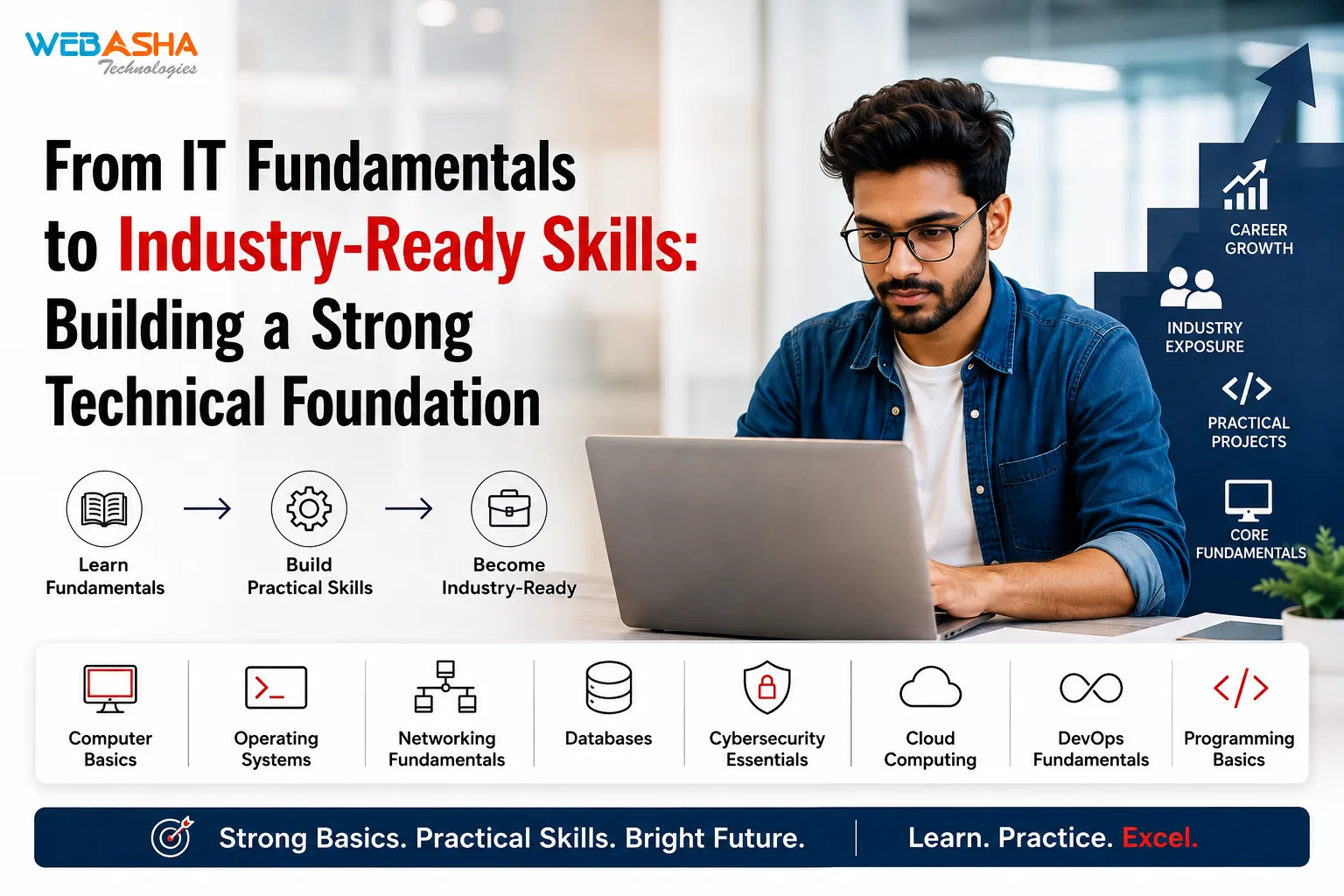
Start with fundamentals: Learn operating systems, basic networking, command-line usage, and core security principles.
Choose a specialization: Focus on cybersecurity, Linux administration, cloud computing, networking, or DevOps according to your interests.
Build practical projects: Complete small exercises and document the problem, process, tools, and results.
Strengthen problem-solving: Practice interpreting logs, diagnosing failures, and explaining technical decisions.
Keep learning: Review documentation, explore new tools, and update your skills as technologies evolve.
Training programs can provide structure, but progress also depends on regular practice, curiosity, and the willingness to learn from mistakes.
Conclusion
A strong IT career foundation is built through technical understanding, practical experience, and continuous improvement. Cybersecurity helps protect digital assets, Linux supports reliable system administration, cloud computing enables modern infrastructure, DevOps improves delivery workflows, and networking connects the systems that organizations depend on.
Rather than trying to master everything at once, learners should develop core fundamentals, choose a focused path, and build experience through practical projects. With consistent effort and relevant learning resources, they can strengthen their technical capabilities and prepare to navigate the changing world of information technology.
Responses (0)
Join the conversation
Sign in to share your thoughts and talk with the author.
Sign in to respondNo responses yet. Be the first to share your thoughts!