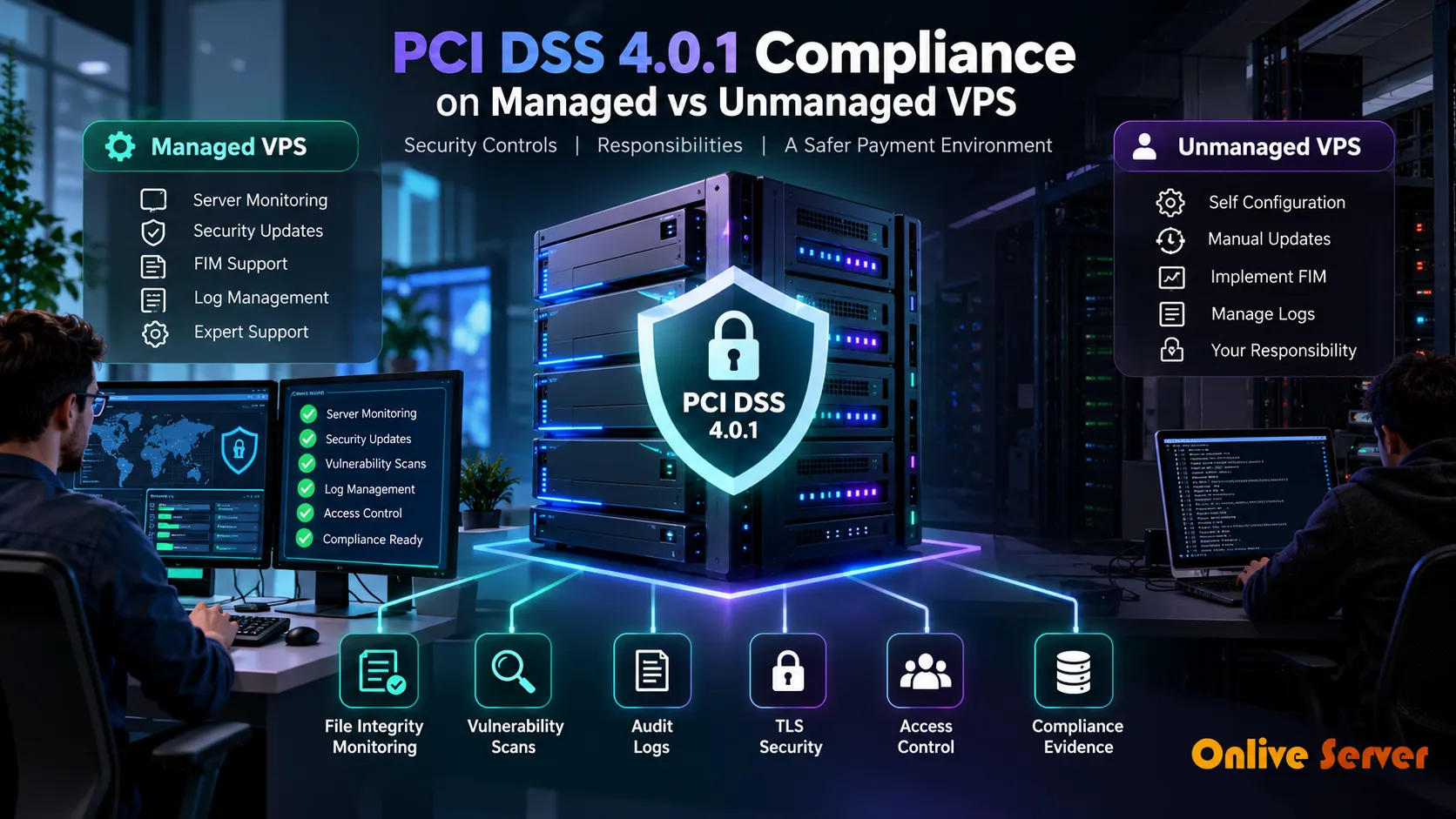

A VPS can have a firewall, SSL certificate, and regular security updates but still fail to meet PCI DSS requirements.
That's because payment security involves more than protecting a server from unauthorized access. Businesses must also monitor security events, control administrative permissions, identify vulnerabilities, and maintain evidence that their security measures are working.
For e commerce businesses and payment-related applications, choosing between managed and unmanaged VPS hosting affects who performs these tasks.
Managed hosting may reduce the technical workload by assigning certain server maintenance responsibilities to the provider. Unmanaged hosting gives businesses greater control but requires their own team to configure and maintain security systems.
Neither option automatically guarantees PCI DSS compliance.
What Does PCI DSS 4.0.1 Mean for VPS Hosting?
The Payment Card Industry Data Security Standard (PCI DSS) establishes security requirements for organizations that store, process, or transmit payment cardholder data, along with systems that can affect the security of the cardholder data environment.
PCI DSS 4.0.1 was released in June 2024. It clarified existing requirements without adding or removing requirements from version 4.0.
For VPS environments, the main security considerations include:
- Controlling network access and administrative permissions.
- Protecting payment data during transmission.
- Monitoring security events and system changes.
- Identifying and correcting vulnerabilities.
- Maintaining security policies and audit records.
Not every business has the same compliance scope.
For example, an online store using a hosted payment page may have fewer systems directly handling card information than a business that processes payment data on its own infrastructure.
However, using a third-party payment gateway doesn't automatically eliminate PCI DSS obligations. The actual requirements depend on how the payment system is designed.
Five Important PCI DSS Security Controls for VPS Hosting
1. Secure Administrative Access and MFA
PCI DSS Requirement 8 addresses user identification and authentication.
For Linux VPS administration, businesses should use individual administrator accounts, restricted permissions, and strong authentication.
SSH key authentication helps protect remote access, while multi-factor authentication (MFA) provides additional protection where required.
Shared administrator credentials should be avoided because they make it difficult to determine who performed a particular action.
Organizations must also review privileged access regularly and remove unnecessary accounts.
These protections help prevent unauthorized users from changing server configurations or accessing sensitive systems.
2. File Integrity Monitoring (FIM)
File Integrity Monitoring detects unexpected changes to important files and configurations.
For example, if someone modifies a critical system file without authorization, an FIM tool can generate an alert.
PCI DSS Requirement 11.5.2 addresses change detection for critical files. It includes alerting personnel about unauthorized modifications and performing critical file comparisons at least weekly.
Linux administrators can use tools such as Wazuh or AIDE to monitor selected files.
However, installing monitoring software isn't enough.
Someone must investigate suspicious alerts, verify whether changes were authorized, and maintain appropriate records.
This is particularly important for ecommerce servers because unauthorized modifications may indicate an attempted compromise.
3. Security Logging and Audit Trails
PCI DSS Requirement 10 covers logging and monitoring access to system components and cardholder data.
Security logs help businesses investigate suspicious activity and understand what happened during an incident.
Important events may include failed login attempts, administrator actions, account changes, and security configuration changes.
On Linux, tools such as auditd can record selected system events.
For environments with multiple servers, centralized logging can make monitoring and investigation easier.
PCI DSS also requires appropriate log protection, retention, and review.
For example, Requirement 10.5.1 requires at least 12 months of audit log history, with the most recent three months immediately available for analysis.
A log collection system is useful only when the organization has a process for reviewing relevant events and responding to suspicious activity.
4. Vulnerability Scanning and Security Updates
New vulnerabilities can appear even when a server was secure during its initial setup.
PCI DSS Requirement 11.3 covers internal and external vulnerability scanning.
Applicable scans must be performed at least once every three months, with additional scanning obligations following certain significant changes.
External scans covered by Requirement 11.3.2 must be conducted by a PCI Security Standards Council Approved Scanning Vendor (ASV).
When vulnerabilities are discovered, administrators need to investigate and remediate them, then complete required rescanning.
A managed hosting provider may assist with operating system patches and server-level remediation.
On an unmanaged VPS, the customer generally handles those responsibilities.
Businesses should confirm separately whether their hosting plan includes vulnerability scanning, because managed hosting doesn't necessarily include ASV services.
5. TLS Encryption and Network Security
PCI DSS Requirement 4 addresses protecting cardholder data transmitted over open, public networks.
For websites, this involves using strong cryptography and secure communication protocols.
TLS 1.2 and TLS 1.3 are commonly supported by modern web servers, although the configuration must meet applicable security requirements.
PCI DSS 4.0.1 does not universally mandate TLS 1.3 specifically.
Administrators should disable obsolete protocols, avoid weak cryptographic configurations, and maintain valid certificates.
Network access also needs attention.
A payment-related VPS should expose only the services required for its applications. Databases that don't require public access should remain restricted to appropriate internal connections.
For additional technical guidance, Onlive Server's article on VPS server hardening covers SSH protection, firewall configuration, software updates, and other Linux security practices.
Managed vs Unmanaged VPS: Who Handles PCI DSS Security?
The primary difference between managed and unmanaged hosting is who maintains the server infrastructure.
In a managed VPS environment, the provider may perform selected security tasks according to the service agreement.
With unmanaged VPS hosting, the customer generally manages operating system security and server administration.
| Security responsibility | Managed VPS | Unmanaged VPS |
|---|---|---|
| Operating system updates | May be provider-managed | Customer |
| Firewall configuration | Depends on support agreement | Customer |
| File integrity monitoring | Must be confirmed | Customer |
| Security log management | May be shared | Customer |
| Vulnerability remediation | Shared by agreed scope | Customer |
| Application security | Generally customer | Customer |
| Compliance documentation | Shared responsibilities | Primarily customer |
These are typical operational differences, not guaranteed features of every hosting plan.
Managed VPS hosting can simplify server administration, but it doesn't transfer all PCI DSS responsibilities to the provider.
Businesses must understand which controls are managed externally and which remain under their own responsibility.
Why Payment Application Security Still Matters
Consider an ecommerce store running on a Linux VPS.
The hosting provider may maintain the operating system and firewall, but the website itself could still contain vulnerable plugins or insecure application code.
A server security update won't automatically fix those application problems.
Similarly, HTTPS protects information during transmission but doesn't prevent every type of payment-page attack.
Businesses using browser-based payment forms should also review the applicability of PCI DSS Requirements 6.4.3 and 11.6.1, which address payment-page scripts and unauthorized changes to payment-page content and relevant security headers.
These requirements are particularly important because attackers may attempt to modify checkout scripts and capture payment information within a customer's browser.
OnliveServer's PCI DSS server compliance guide for Linux provides further information about securing payment-related server environments.
What Evidence Is Needed for PCI DSS Compliance?
Security controls must be supported by appropriate documentation and testing records.
During a compliance assessment, an organization may need to demonstrate that its policies and technical safeguards are actually being followed.
Depending on its PCI DSS scope, useful evidence can include:
- Records of administrator access and permissions.
- Vulnerability scan reports and remediation results.
- Security log review and investigation records.
- File integrity monitoring alerts.
- Firewall configuration and change records.
- Applicable hosting provider compliance documentation.
A business shouldn't wait until an assessment to collect this information.
Regular monitoring and recordkeeping make it easier to identify security weaknesses and demonstrate that required controls are operating.
Does Managed VPS Hosting Make PCI DSS Compliance Easier?
Managed VPS hosting can help organizations that don't have dedicated Linux administrators or security engineers.
If the provider maintains operating system patches, supports server monitoring, and assists with infrastructure incidents, the internal team may have fewer routine administration tasks.
However, the organization must verify the exact services provided.
PCI DSS Requirement 12.8 addresses managing third-party service provider relationships. This includes understanding applicable responsibilities and monitoring relevant provider compliance status.
A provider's compliance documentation should be reviewed to determine which services and systems it actually covers.
An unmanaged VPS may be suitable for organizations with qualified technical teams that need full administrative control.
The better hosting choice depends on the payment architecture, internal expertise, required security controls, and available support.
Responses (0)
Join the conversation
Sign in to share your thoughts and talk with the author.
Sign in to respondNo responses yet. Be the first to share your thoughts!