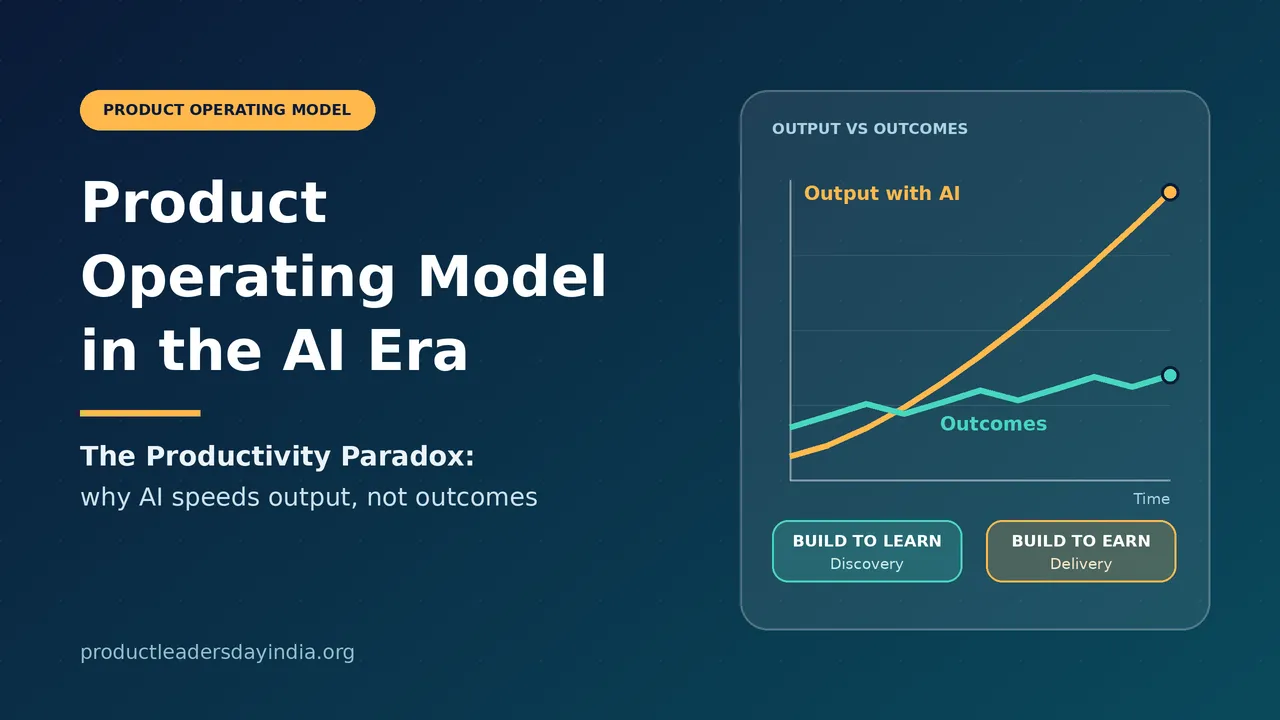

If your team ships faster since adopting AI coding tools but customer metrics look the same, you are not imagining things. Marty Cagan named this the AI productivity paradox in July 2026. The tools work. The operating model around them often does not turn speed into results.
Two modes of building
Cagan separates build to learn from build to earn. Engineers will recognize both.
Build to learn is discovery. Prototypes built with tools like Figma, v0, Lovable or Claude exist to test an assumption about value, usability, feasibility or viability. They are disposable. Build to earn is delivery. Here the code has to meet commercial standards: reliability, accuracy, performance and scalability, with monitoring and a rollback plan.
The danger is blurring the two. A convincing prototype is not proof that people want the product, and vibe coding is fine for learning but risky when a quick prototype ships to customers as if it were production software.
An engineering gate between prototype and production
The guide offers an eight-point gate. Before something moves to build to earn, check that:
- there is evidence the solution is valuable to target customers;
- usability was tested with real users;
- the business has confirmed viability across legal, finance, sales, service and marketing;
- engineers have confirmed feasibility;
- the outcome metric and its baseline are defined;
- reliability, accuracy, performance and scalability meet commercial standards;
- monitoring and instrumentation are in place;
- there is a rollback plan and a human owner for production.
Fewer than five ticks means keep it a prototype. Five to seven means close, so resolve the gaps. All eight means it is ready for commercial-quality delivery. You can make the gate a required step in your pull request template on GitHub or GitLab, or in your Jira workflow, and use staged rollouts with LaunchDarkly, Statsig or Optimizely.
Evals for AI features
If what you ship is itself an AI feature, you need a new habit. Teresa Torres of Product Talk calls it evals: write down what good looks like, test outputs systematically and track quality over time instead of judging by feel. In practice that means four checkpoints.
- Discovery: does the output solve the customer problem well enough to be valuable?
- Pre-release: does quality meet the threshold for commercial use, for example a pass rate on a fixed test set?
- Post-release: is quality holding up, based on flagged outputs, complaints and corrections?
- Change: did a prompt, model or data change make things better or worse on the same test set?
Tools such as Langfuse, LangSmith, Braintrust or Promptfoo can help, but any equivalent works.
Governance that engineers can live with
Give every AI-assisted decision that reaches customers a named human owner. Keep prototype environments and data apart from production. Note which parts of a spec or analysis were drafted by AI and who checked them. Do not put customer data into tools your security and legal teams have not approved, and review AI incidents without blame.
Judge AI by outcomes, not lines of code
A code assistant measured by lines generated is an output metric. A stronger one is cycle time and defect trends for shipped changes.
Templates for the experiment card and the production-readiness note are in the full guide: https://productleadersdayindia.org/blogs/ai-driven-product-operating-model/product-operating-model-in-the-ai-era.html
Responses (0)
Join the conversation
Sign in to share your thoughts and talk with the author.
Sign in to respondNo responses yet. Be the first to share your thoughts!