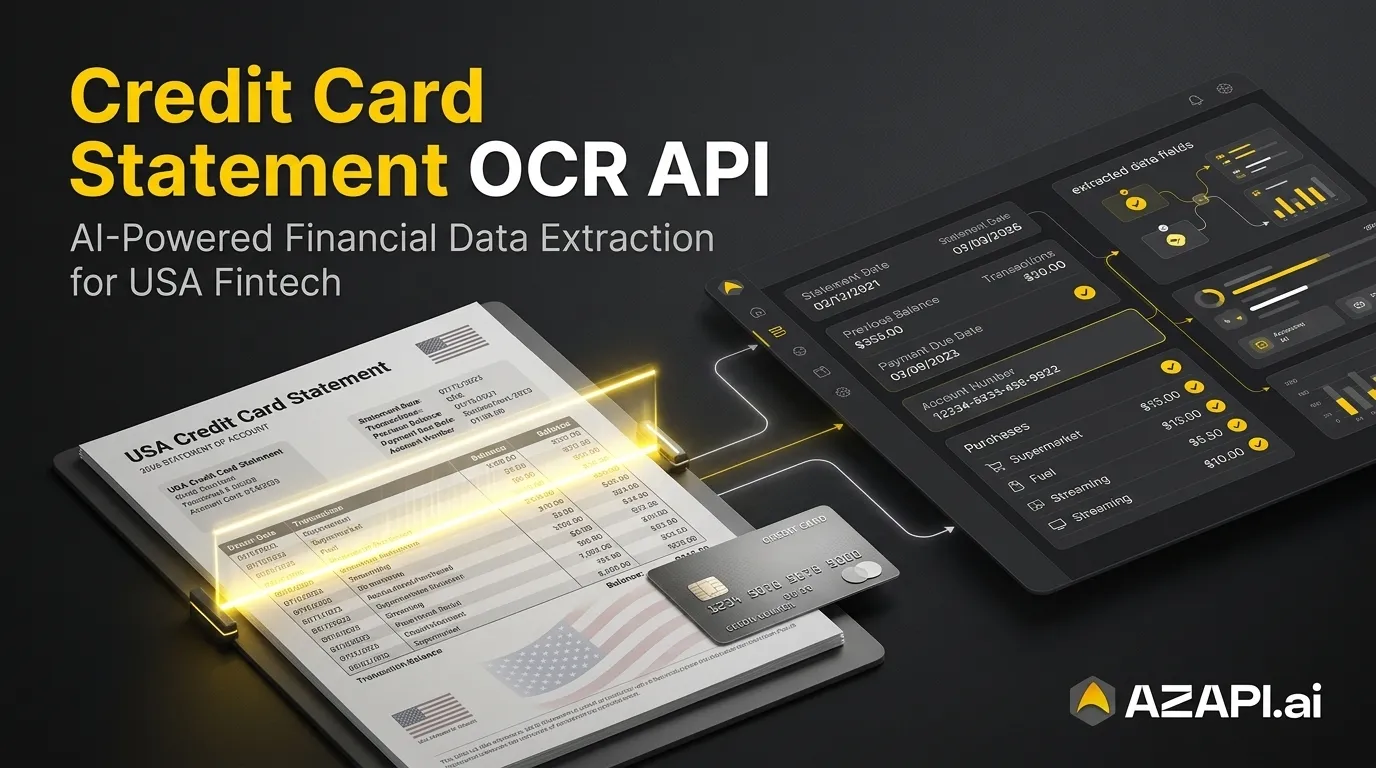

Credit Card Statements OCR API for USA: Building Structured Financial Data Extraction Workflows
Credit card statements are an important source of financial information for fintech applications, lending platforms, accounting software, and expense management systems. However, extracting usable data from these documents is not always straightforward. Statement layouts, transaction descriptions, billing periods, and account information can vary between financial institutions.
For developers building financial applications, this creates a document-processing challenge: how can information from different credit card statements be converted into a consistent, structured format without relying entirely on manual data entry?
A Credit Card Statements OCR API for USA can help address this challenge by recognizing document text and converting available statement information into digital data that applications can process.
Why Credit Card Statement Data Extraction Is Challenging
Credit card statements contain several types of information, often arranged in different sections and layouts. Common fields include:
- Cardholder and account details
- Statement closing date and billing period
- Transaction dates and descriptions
- Transaction amounts and payment entries
- Previous and current balances
- Minimum payment and payment due date
- Credit limit and available credit, where present
The difficulty is not limited to recognizing individual words or numbers. Developers also need to organize extracted information so that an application can identify which values belong to account details, transaction records, or billing information.
For example, a transaction table may contain multiple entries with similar descriptions. The extraction workflow needs to preserve the relationship between each transaction date, description, and amount.
How OCR Helps Convert Statements into Structured Data
Optical Character Recognition (OCR) converts text appearing in document images or scanned files into machine-readable information.
When applied to credit card statements, an OCR-based workflow can help with:
1. Document text recognition
The OCR process identifies text appearing in uploaded statement documents, including account information, transaction entries, dates, and amounts.
2. Field-level information extraction
Recognized text can be organized into relevant categories, such as cardholder details, statement periods, balances, and payment information, depending on what is available in the document.
3. Transaction data organization
Transaction dates, descriptions, and amounts can be extracted as individual records. This makes the information easier to process within accounting, reporting, or expense management applications.
4. Structured digital output
Instead of working directly with unorganized text, applications can use structured data to support downstream processing and database operations.
What Developers Should Consider When Integrating a Credit Card Statements OCR API
Selecting an OCR solution is only one part of building a reliable document-processing workflow. Developers should also consider how extracted information will be handled by the application.
Handling Different Statement Layouts
Credit card statements from different financial institutions may use different layouts, labels, and transaction table structures. An extraction workflow should account for variations rather than assume every document follows an identical template.
Managing Missing or Unavailable Fields
Not every statement contains every possible field. Applications should distinguish between information that is present, information that is unavailable, and information that could not be extracted. This helps prevent missing values from being treated as actual zero values or incorrect data.
Preserving Transaction Relationships
Transaction records should remain organized as separate entries. Combining dates, descriptions, and amounts incorrectly can create problems for expense tracking, reconciliation, and reporting.
Reviewing Extracted Information
OCR output should be treated as extracted document data, not automatically as verified financial information. Applications may need additional validation rules, exception handling, or human review depending on their use case.
Planning API Integration
An API-based approach allows developers to connect document extraction capabilities with existing applications. Before deployment, teams should evaluate the API's input requirements, output structure, error handling, security practices, and integration documentation.
Where Credit Card Statement OCR Can Be Used
Structured statement extraction can support several types of applications:
- Fintech platforms: Organizing financial document information for application workflows.
- Lending platforms: Extracting available statement details for document review processes.
- Accounting software: Organizing transaction information for financial record management.
- Expense management applications: Capturing transaction details for expense-related workflows.
- Financial service providers: Digitizing statement information for internal processing.
The exact use case depends on the application's requirements and the information available in each statement.
Exploring AZAPI Credit Card Statements OCR API for USA
AZAPI.ai offers a Credit Card Statements OCR API for USA designed to help businesses extract available information from credit card statements and convert it into structured digital data.
The API is relevant to developers and businesses working on financial document digitization, transaction data extraction, and automated document-processing workflows.
It can help organize information such as transaction dates, descriptions, amounts, statement periods, balances, and payment due dates where present in the source document.
For teams evaluating an OCR-based approach, the solution provides an option to explore API-driven credit card statement data extraction and integration into existing applications.
Conclusion
Building a credit card statement processing workflow involves more than recognizing text. Developers need to consider document layout variations, transaction relationships, missing fields, structured output, and downstream application requirements.
A Credit Card Statements OCR API for USA can help reduce repetitive manual data entry by converting available statement information into structured digital data. With appropriate review and application-level validation, OCR-based extraction can become a useful part of financial document processing workflows.
Responses (0)
Join the conversation
Sign in to share your thoughts and talk with the author.
Sign in to respondNo responses yet. Be the first to share your thoughts!