
How Utility Bill OCR APIs Simplify Document Data Extraction
Utility bills contain important information that businesses frequently need for customer onboarding, address documentation, financial services, and digital record management. However, collecting this information manually can become repetitive when documents come from different utility providers and follow different layouts.
Electricity, water, gas, and internet bills may present similar information in different formats. This creates a document-processing challenge for businesses that handle a large number of customer applications.
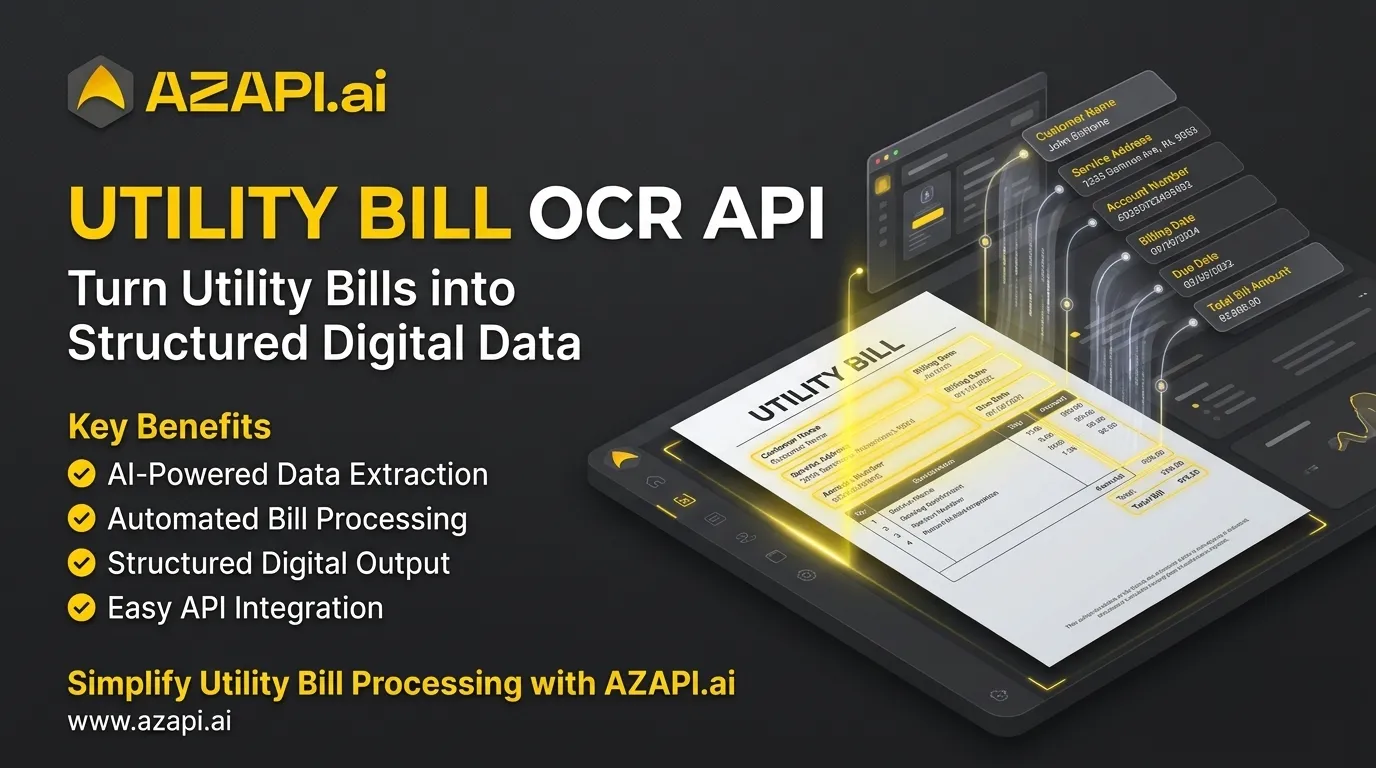
A Utility Bill OCR API can help address this challenge by extracting relevant information from bill documents and converting it into structured digital data.
What Is a Utility Bill OCR API?
A Utility Bill OCR API is an application programming interface that uses Optical Character Recognition (OCR) technology to read text from utility bill documents.
Instead of requiring someone to manually read a bill and enter its details into an application, an OCR-based workflow can process the document and extract available information.
Depending on the document, extracted fields may include:
- Customer name
- Service or billing address
- Utility provider name
- Account or consumer number
- Billing date
- Billing period
- Payment due date
- Total bill amount
The extracted information can then be used by connected applications for further processing.
Why Manual Utility Bill Processing Can Be Challenging
Businesses often receive utility bills from multiple providers. Even when the same information is required, its position and presentation can vary between documents.
Some common challenges include:
1. Different Document Layouts
Electricity, water, gas, and internet providers may use different bill templates. Important details may appear in different sections or under different labels.
2. Repetitive Data Entry
Manually entering customer names, addresses, account numbers, and billing information takes time and introduces opportunities for typing errors.
3. Document Volume
Businesses processing many customer applications may need a more organized way to collect information from utility documents.
4. Application Integration
Extracted information often needs to move into existing onboarding applications, databases, or document management workflows.
How Utility Bill OCR Works
An API-based utility bill extraction workflow generally involves the following steps:
Step 1: Submit the Utility Bill
The application sends a utility bill document to the OCR API through an integration.
Step 2: Text Recognition
OCR technology processes the document and identifies readable text, including information presented in different sections.
Step 3: Information Extraction
Relevant fields are identified and extracted, depending on the document's content and supported extraction capabilities.
Step 4: Structured Data Output
The extracted information is returned in a structured format that the connected application can process.
Step 5: Application-Level Processing
The business application can store the extracted information, display it to users, or pass it to another workflow.
It is important to distinguish data extraction from document authentication. OCR extracts information from a document, but it does not independently establish whether a bill is genuine or whether an address is valid.
Where Can Utility Bill OCR Be Used?
Utility bill data extraction can support several business workflows.
Customer Onboarding
Applications can use extracted customer and address information to reduce repetitive manual data entry during onboarding.
KYC Related Workflows
Businesses handling KYC related documentation can use OCR to collect available information from utility bills for subsequent review and processing.
Proof-of-Address Processing
Utility bills are commonly submitted as address documents. OCR can help extract the printed address and related customer information for further application-level checks.
Fintech Applications
Financial technology platforms may process utility bills as part of customer documentation workflows. API-based extraction can help make this information available to connected applications.
Document Management
Organizations can use structured extraction to organize utility bill information and reduce the need to manually review every field for data entry.
What Developers Should Consider When Choosing a Utility Bill OCR API
Before integrating an OCR API, developers should evaluate it against their actual document-processing requirements.
Some important considerations include:
- Field coverage: Check whether the API extracts the information your application requires.
- Document variations: Test bills from different providers and layouts.
- Output structure: Review how extracted fields are returned and how easily they can be mapped into your application.
- Integration requirements: Understand the API request, response, and authentication process.
- Error handling: Consider how your application will handle missing, unclear, or incorrectly recognized information.
- Data privacy: Review document handling, storage, and security practices before processing customer documents.
Testing with representative utility bills is important because document quality, layout variations, and available information can affect extraction results.
Exploring AZAPI Utility Bill OCR API
AZAPI provides a Utility Bill OCR API designed to extract useful information from utility bill documents.
The solution focuses on making details such as customer names, service addresses, account numbers, billing dates, due dates, and bill amounts available for further processing, depending on the information present in the document.
Developers and businesses can explore its integration possibilities for customer onboarding, proof-of-address document processing, KYC related workflows, and other document-heavy applications.
Conclusion
Utility bill processing is an important part of many customer documentation and onboarding workflows. Different bill layouts and repetitive manual data entry can make information collection challenging for businesses.
A Utility Bill OCR API provides a practical way to extract available information from utility documents and make it accessible to connected applications. By evaluating field coverage, document variations, output structure, and integration requirements, developers can determine how OCR fits into their existing workflows.
As businesses continue to digitize document-heavy processes, API-based OCR can help make utility bill data extraction more organized and easier to manage.
Responses (0)
Join the conversation
Sign in to share your thoughts and talk with the author.
Sign in to respondNo responses yet. Be the first to share your thoughts!