
Businesses serving customers across North and South America face an important infrastructure decision: where should their applications be hosted to maintain acceptable performance across different countries?
A VPS America deployment can provide a practical starting point for applications serving users in the United States, Canada, Mexico, and Latin America. Instead of maintaining separate servers in every market, businesses can operate their core applications from a strategically selected US data center.
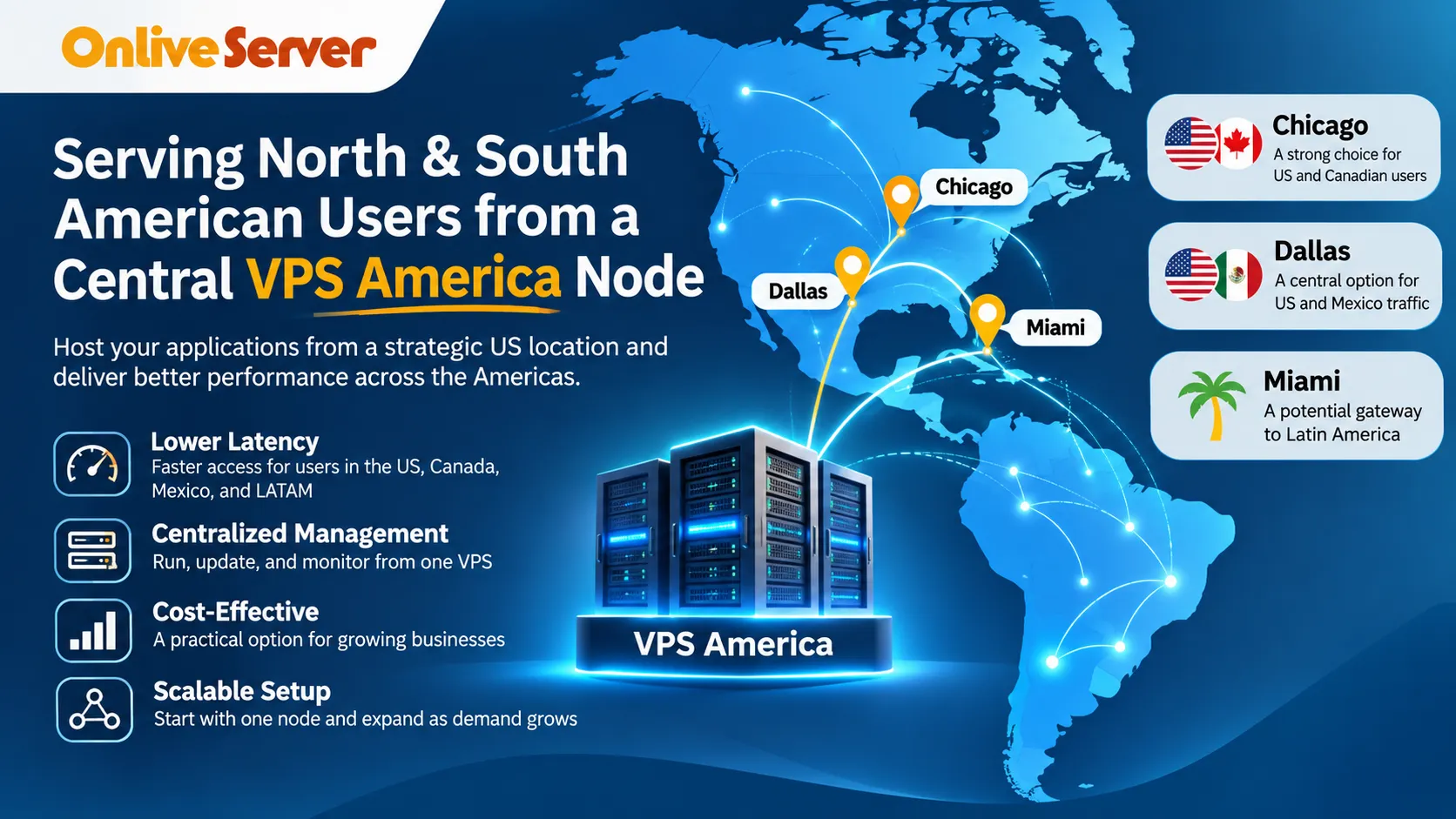
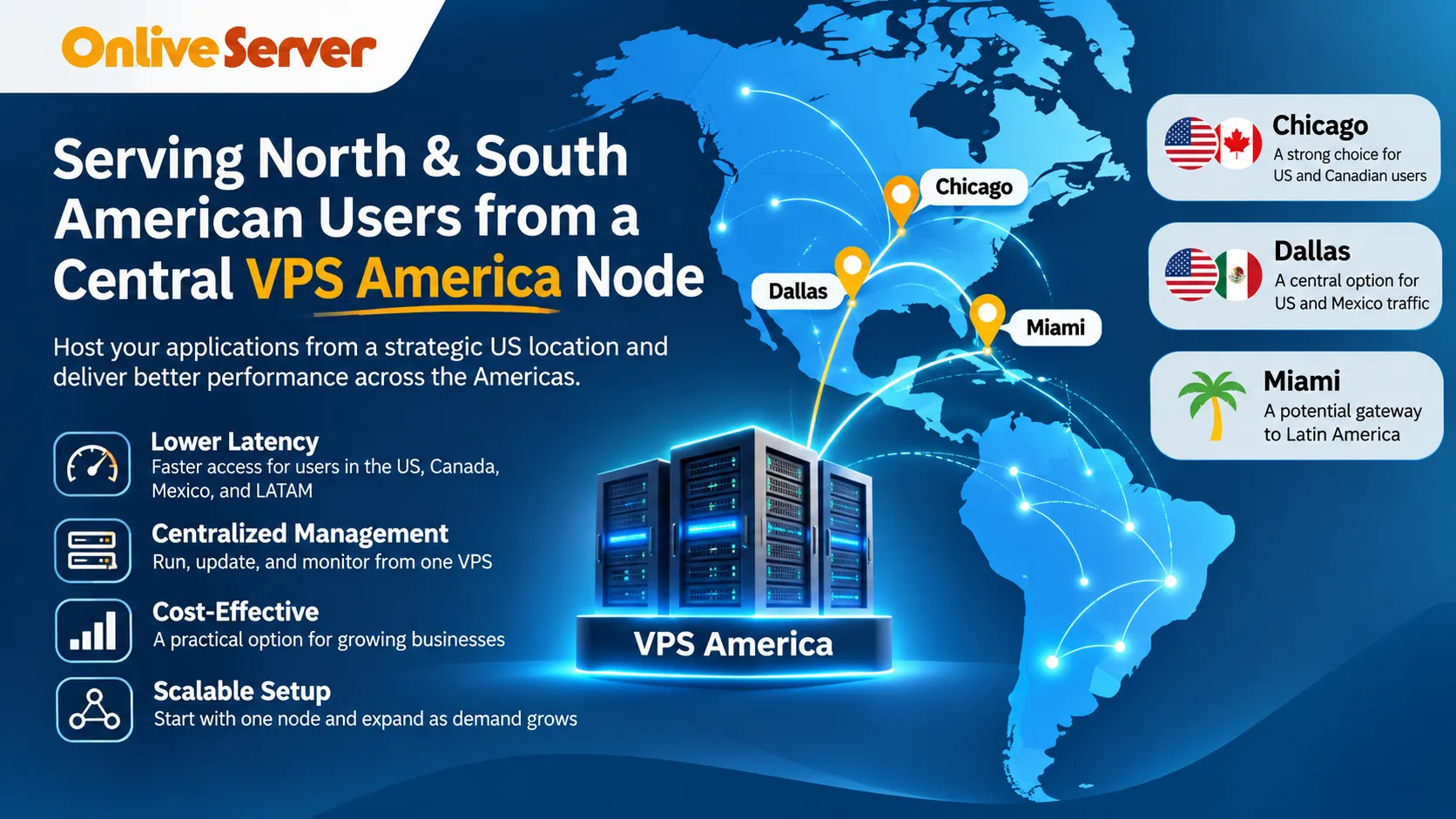
Dallas, Chicago, and Miami are three locations worth evaluating because each offer different geographic advantages. The right choice depends on user distribution, network routing, application requirements, and the hosting provider's connectivity.
Why Server Location Matters for American Markets
Server location influences how quickly information travels between an application and its users. Every request passes through network infrastructure before reaching the hosting server.
The time required for data to travel between two endpoints is called network latency. Higher latency can affect API responses, database-dependent operations, and interactive applications.
For example, a customer accessing an application from Toronto may experience different response times depending on whether its server is located in Chicago, Dallas, or Miami.
Geographic distance matters, but internet traffic does not always follow the shortest physical path. Internet service providers use routing arrangements that can send traffic through unexpected locations.
Cloudflare's documentation confirms that routing changes, congestion, and network maintenance can influence which facilities process traffic.
Cloudflare Support docs
For this reason, choosing a North America VPS requires more than looking at a map.
Dallas: A Central Option for North American Traffic
Dallas is worth considering for businesses serving customers across the United States and Mexico.
Its south-central US location makes it a reasonable candidate for applications with geographically distributed American users.
A Dallas VPS may suit:
- E-commerce applications serving US and Mexican customers.
- SaaS dashboards accessed from multiple American states.
- Business APIs supporting cross-border operations.
- Customer portals requiring centralized data management.
Dallas can provide a useful compromise when user traffic is distributed across several regions rather than concentrated on one coast.
Still, developers should test connectivity from actual customer locations. A geographically central server does not automatically deliver the lowest latency to every destination.
Chicago: Supporting US and Canadian Users
Chicago is another location to evaluate when a significant share of application traffic comes from the northern United States or Canada.
Organizations serving customers in Toronto, Montreal, and major US cities may find Chicago suitable for centralized application hosting.
The location can be particularly relevant for business software, financial dashboards, subscription platforms, and enterprise applications.
For developers, the main consideration is not simply the distance between Chicago and Canadian cities. Network peering, ISP routing, and the hosting provider's upstream carriers also influence performance.
A Chicago-based deployment should therefore be tested against alternatives using real network measurements before becoming the primary production environment.
Miami: A Potential Gateway to Latin America
Miami deserves attention when an application serves a substantial Latin American audience.
Businesses targeting Mexico, Colombia, Brazil, Argentina, and other markets often need to consider international connectivity as carefully as server resources.
Miami's position in the southeastern United States makes it a logical candidate for testing connections toward the Caribbean and parts of Latin America.
Potential use cases include regional payment applications, travel booking platforms, multilingual websites, and business management software.
Yet Miami should not automatically be considered the fastest option for all South American customers.
A user connecting from São Paulo may experience different network conditions than someone connecting from Bogotá or Mexico City. International transit routes and carrier relationships can significantly influence the results.
Understanding Latency Routing Across the Americas
When users access a VPS-hosted application, their requests travel through multiple networks before reaching the server.
The route depends on ISP connectivity, routing policies, network congestion, and other infrastructure conditions.
Consider three deployment scenarios:
| VPS location | Region to evaluate | Main consideration |
| Dallas | Central US and Mexico | Geographic balance and cross-border connectivity |
| Chicago | Northern US and Canada | Connectivity to Canadian and Midwest networks |
| Miami | Caribbean and Latin America | International carrier routes and transit quality |
These are candidate locations, not guaranteed performance rankings.
Developers should compare round-trip time, packet loss, and application response times from representative networks in each target country.
AWS also recommends measuring network latency before selecting a deployment region rather than relying exclusively on geographic assumptions.
Networking & Content Delivery
Why a Central VPS America Node Can Simplify Infrastructure
Operating applications from one primary VPS can reduce infrastructure complexity, particularly for startups and small development teams.
A centralized deployment allows administrators to manage application updates, databases, authentication systems, and monitoring from one environment.
It can also simplify troubleshooting because the application has fewer geographically distributed components.
Businesses exploring VPS America hosting can review OnliveServer's US VPS hosting options when planning a centralized deployment.
Before selecting any plan, developers should confirm the available data center locations, CPU and memory allocation, storage specifications, bandwidth limits, and network connectivity.
A single VPS can be cost-effective for suitable workloads, but it also creates a potential single point of failure unless an independent recovery or failover arrangement exists.
Improving Performance Beyond Server Location
Selecting a suitable data center is only the beginning. Application architecture also affects how quickly users receive content.
Developers can improve regional performance by using several practical techniques.
Content delivery networks: A CDN can cache static assets closer to users, reducing repeated requests to the origin VPS.
Database optimization: Efficient queries, appropriate indexing, and connection management reduce application processing time.
Application caching: Redis or similar caching systems can reduce repeated database operations.
Compression: Compressing supported responses reduces transferred data, particularly for text-based content.
Network monitoring: Continuous measurements help identify increased latency, packet loss, or routing changes.
These improvements are especially valuable when one server supports customers across several countries.
They cannot remove every limitation of a distant origin server, particularly for uncached, latency-sensitive operations.
When Should Businesses Consider Multiple VPS Locations?
A centralized VPS is not always sufficient.
Applications with strict latency requirements, large geographically dispersed audiences, or demanding availability targets may benefit from deploying services in multiple regions.
For example, a business might operate its primary application in Dallas while maintaining another application instance closer to a large South American customer base.
Latency-based traffic routing can then direct users toward suitable endpoints, provided the application supports the required architecture.
AWS documents this approach as an option when no single region provides satisfactory latency for all users.
Performance Efficiency Pillar
Multi-region infrastructure also introduces additional responsibilities, including database replication, traffic management, synchronization, and failover testing.
Businesses should adopt it when measured performance or availability requirements justify the extra operational work.
Conclusion
A central VPS America node can be a practical hosting approach for businesses serving North and South American customers without operating infrastructure in every country.
Dallas is worth evaluating for distributed US and Mexican traffic, Chicago for northern US and Canadian audiences, and Miami for applications with significant Latin American demand.
No single city guarantees the best performance across the Americas. Actual results depend on carrier routing, network quality, application design, and where customers connect from.
For developers planning a North America VPS deployment, the strongest approach is to measure real latency, select a suitable location, and optimize application performance before expanding into additional regions.
A carefully chosen US VPS can provide an effective foundation for regional growth while keeping infrastructure manageable.
Responses (0)
Join the conversation
Sign in to share your thoughts and talk with the author.
Sign in to respondNo responses yet. Be the first to share your thoughts!