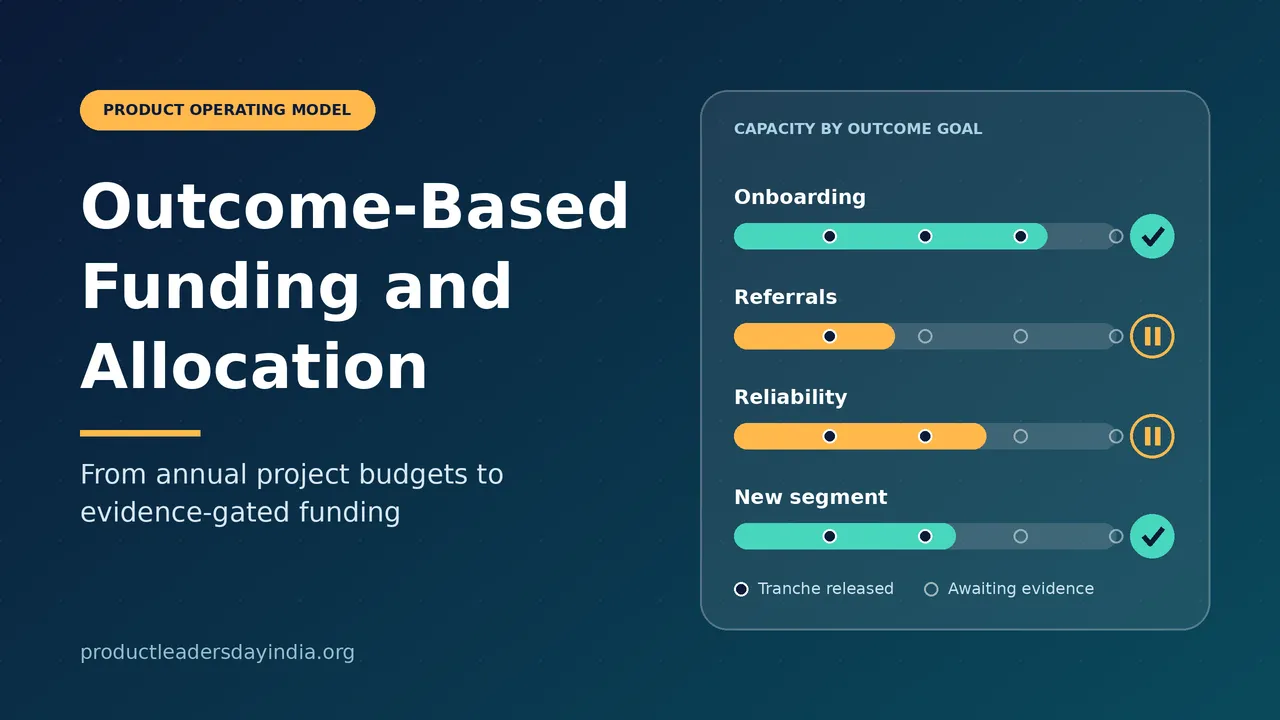

Engineering teams are usually the first to feel the downside of output-based planning. A fixed list of features arrives, a deadline is attached, and success is defined as shipping on time. Nobody asks whether the feature changed customer behavior. Outcome-based funding tries to fix this at the root by changing how resources are released.
Two mechanisms, one goal
Outcome-based allocation spreads a portfolio's capacity across outcome goals and checks planned share against actual share. Outcome-based funding releases resources to one product over time as agreed milestones are met. Engineers will recognize the pattern: allocation is like capacity planning across services, and funding is like a progressive rollout that expands only when the metrics look healthy.
Instrumentation is a prerequisite, not an extra
Step three of the guide's sequence is the one engineers can influence most. If the product cannot show whether an outcome moved, funding decisions turn into opinions. Before a team accepts an outcome, check the baseline in your analytics stack, such as Amplitude, Mixpanel or PostHog, and confirm that dashboards in a tool like Looker, Power BI or Metabase can display the trend. Record the agreed outcome next to the work in Jira, Linear or Azure DevOps so the link between a ticket and a result is visible.
What a real outcome looks like
The guide offers a six-point quality check. A real outcome:
- describes a change in customer behavior or a business result, not something we build;
- has a baseline, a target and a timeframe;
- is something the team can directly influence;
- can be observed because the product is instrumented;
- leaves the choice of solution to the team, not a stakeholder;
- has a named person accountable.
Score below four and it is probably an output in disguise.
Rewriting key results
Compare "Launch one-click checkout by Q3" with "Reduce checkout abandonment from [baseline] to [target] by [date]." The first is a delivery milestone. The second gives the team room to choose between a new flow, fewer form fields or better error handling. The outcome version is harder to write because it demands a baseline and a way to measure, and that difficulty is the point.
Decision rights matter
The outcome brief template includes a line many teams skip: the team chooses the solution, and escalation happens only under stated conditions. It also asks for the four discovery risks (value, usability, feasibility and viability) and an evidence plan describing what would change the team's mind. Constraints are listed only when mandatory, with a reason for each.
Review cadence
Monthly reviews look at outcome movement and flow. Quarterly reviews reallocate capacity and release, hold or stop funding. Annual planning sets top-level goals and funding envelopes. This replaces the delivery status meeting, so engineers spend less time producing slides and more time on evidence such as cycle time and release frequency.
Pitfall to watch
Releasing or withholding money too quickly pushes teams toward short-term metrics. Tranches should follow evidence, including evidence that an idea is not working, which is a perfectly good reason to stop.
Templates for the outcome brief, funding release memo and quarterly bets are in the full guide: https://productleadersdayindia.org/blogs/ai-driven-product-operating-model/outcome-based-funding-and-allocation.html
Responses (0)
Join the conversation
Sign in to share your thoughts and talk with the author.
Sign in to respondNo responses yet. Be the first to share your thoughts!