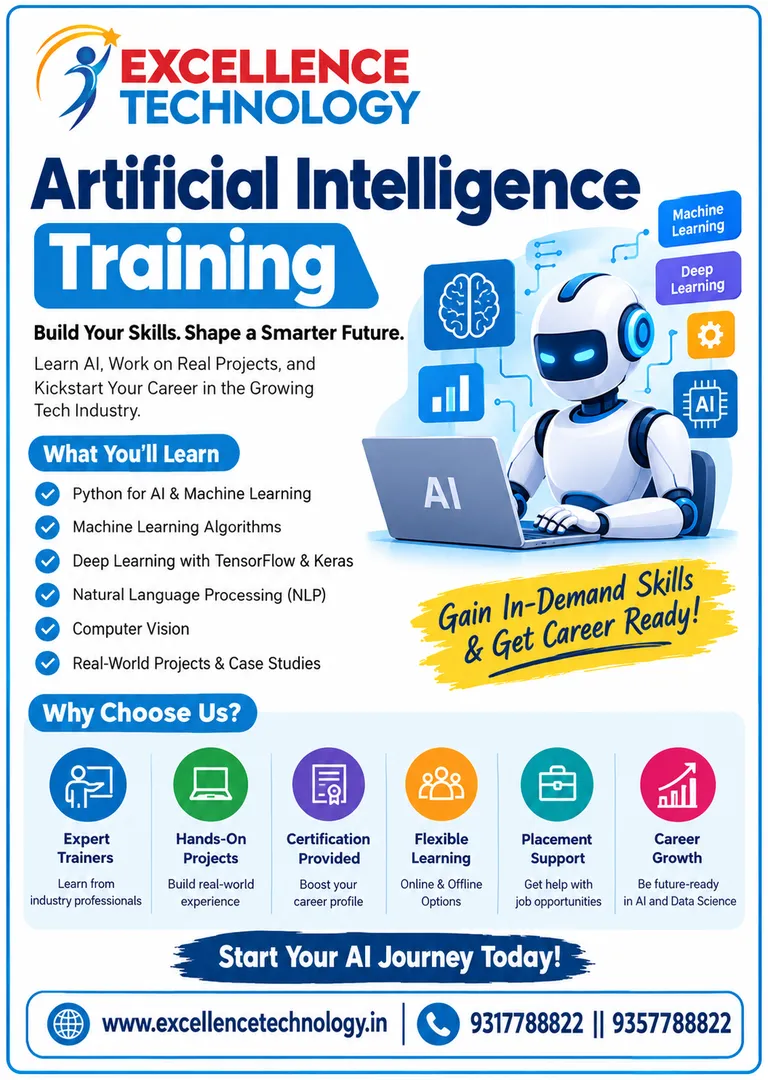

Artificial intelligence is changing how businesses work, solve problems, and make decisions. As a result, many students and professionals are exploring careers in AI and looking for the right skills to enter this growing field. However, one common question remains: What are the actual AI training job requirements, and which skills should you learn first?
The good news is that you do not always need an advanced degree or years of programming experience to begin learning AI. The skills you need depend on your target role, whether you want to become an AI engineer, machine learning developer, data analyst, or AI specialist.
In this guide, we will explain the essential AI skills, educational qualifications, practical experience, and training options that can help you prepare for an AI career.
Quick Answer: What Are the AI Training Job Requirements?
Most AI-related jobs require a combination of technical knowledge, analytical thinking, and practical experience. Common requirements include basic mathematics, Python programming, data analysis, machine learning fundamentals, and familiarity with AI tools. Employers may also expect project experience, communication skills, and a relevant degree or certification, depending on the position. Beginners can start with foundational AI training and gradually develop advanced skills through hands-on practice.
1. Educational Qualifications for AI Jobs
Educational requirements vary according to the role and employer. For example, many AI engineer and machine learning positions prefer candidates with degrees in computer science, information technology, mathematics, statistics, or related fields.
However, a degree is not the only way to build relevant skills. Students from other educational backgrounds can also enter AI-related careers by learning programming, understanding data, and completing practical projects. Additionally, a structured IT training program can help beginners develop the technical foundation needed for entry-level opportunities.
Therefore, focus on building demonstrable skills alongside your education. Employers often evaluate your ability to solve problems, explain your work, and apply AI concepts to real situations.
2. Python Programming and Technical Skills
Python is one of the most useful programming languages for artificial intelligence and machine learning. It has a large ecosystem of libraries that make it easier to process data, build models, and develop AI applications.
Start by learning variables, loops, functions, lists, dictionaries, and object-oriented programming. Once you understand these basics, move on to libraries such as NumPy, pandas, and scikit-learn.
Furthermore, explore basic SQL for working with databases and Git for managing code. These skills can make your workflow more efficient and help you collaborate with other developers.
If you are a complete beginner, do not try to master every programming language at once. Instead, develop a strong understanding of Python and gradually expand your technical knowledge.
3. Mathematics, Statistics, and Data Analysis
Mathematics helps you understand how AI models learn from data. You do not need to become a mathematician before starting, but a working knowledge of essential concepts is valuable.
Begin with basic algebra, probability, statistics, and an introduction to linear algebra. These topics help explain model predictions, patterns, uncertainty, and the relationships between variables.
Equally important, learn how to clean, organize, and analyze data. Real-world datasets often contain missing values, inconsistent formats, and errors. Consequently, data preparation is an important skill for many AI and machine learning jobs.
Practice using spreadsheets, Python, and simple visualizations to turn raw information into useful insights.
4. Machine Learning and Generative AI Knowledge
After learning the fundamentals, explore machine learning concepts such as supervised learning, unsupervised learning, classification, regression, and model evaluation.
Next, become familiar with generative AI tools, large language models, prompt engineering, and retrieval-augmented generation (RAG). Depending on your career goals, you may also study neural networks, deep learning, and natural language processing.
For practical learning, explore the official Google Machine Learning resources. These materials can help you understand key concepts and develop your technical foundation.
Additionally, learn to evaluate AI outputs instead of accepting every response as correct. Understanding bias, privacy, accuracy, and responsible AI use is essential when developing or applying AI solutions.
5. Hands-On Projects and Practical Experience
Knowing AI theory is helpful, but practical experience demonstrates what you can actually do. Therefore, create projects that solve clear problems and allow you to explain your approach.
For example, build a simple chatbot, create a sales prediction model, classify customer reviews, or develop a document-question-answering application. Start with small projects and gradually increase their complexity.
Upload suitable projects to GitHub and document the problem, tools used, process, results, and limitations. This creates a portfolio that employers can review when assessing your abilities.
You can also explore WhiteHat Coders for additional technology-related learning information and resources. Choose projects and learning materials that match the requirements of your intended role.
6. Communication, Critical Thinking, and Problem-Solving
AI professionals do more than write code. They must understand business problems, explain technical decisions, and work with people from different departments.
For instance, an AI developer may need to explain why a model produces inaccurate predictions or how a solution can improve a company's workflow. Clear communication makes these discussions easier.
Critical thinking is equally important because AI-generated results can be incomplete, misleading, or incorrect. As a result, you should learn to verify information, test assumptions, and identify potential risks before using AI outputs.
Develop these skills through group projects, presentations, technical writing, and regular problem-solving practice.
7. AI Certifications and Training Courses
AI certifications can demonstrate your commitment to learning, especially when you are new to the industry. However, a certificate alone does not guarantee employment. Employers may also consider your technical knowledge, portfolio, and ability to complete practical tasks.
Choose a course that covers Python, data analysis, machine learning fundamentals, and real-world projects. Advanced courses may include cloud AI services, model deployment, or generative AI application development.
Before enrolling, review the curriculum, trainer experience, project work, and career support. You can explore Excellence Technology to learn about available technology training options and select a program that aligns with your goals.
8. How to Prepare for an AI Job as a Beginner
Start by identifying your preferred career path. For example, AI application development may require stronger programming skills, while an AI-focused data role may emphasize statistics and data analysis.
Next, follow a consistent learning plan. Spend the first few weeks learning Python and basic mathematics, then practice data analysis and machine learning. After that, develop two or three meaningful projects and prepare to explain your decisions during interviews.
Meanwhile, improve your resume and professional profile by highlighting relevant skills, projects, coursework, and certifications. Apply for internships and junior roles that match your current abilities.
Most importantly, keep learning. AI technologies evolve quickly, so regularly updating your knowledge can help you remain adaptable and competitive.
Conclusion
The actual AI training job requirements depend on the role you want to pursue. Nevertheless, Python programming, data analysis, mathematics, machine learning fundamentals, practical projects, and problem-solving are valuable starting points for many AI careers.
You do not need to learn everything at once. Begin with the fundamentals, build real projects, and gradually specialize in an area that interests you. With consistent practice and a clear learning plan, you can develop the skills needed to pursue suitable AI-related opportunities.
Ready to start learning AI? Explore relevant training programs, build your first project, and take the next step toward your technology career.
Responses (0)
Join the conversation
Sign in to share your thoughts and talk with the author.
Sign in to respondNo responses yet. Be the first to share your thoughts!